Bound an operating period for warehouse activity, deposit entry, and close/lock controls.
## At a glance
- **Identify it by:** **Parent**, **Opening Date**, **Closing Date**, and **Warehouse**.
- **Check its business context:** **Parent**, and **Warehouse**.
- **Why care:** Dates, accounts, amounts, posting state, and period locks can change financial reports. Verify them against the source document before finalizing the record.
- **Why care:** Treat posted, processed, paid, reversed, and edit-locked states as controls—not ordinary descriptive fields. Confirm the source transaction before changing any state that the screen permits you to change.
## Before you begin
You need the Brisk permission for the action you are taking on work periods. If a Create, Edit, or Delete control is absent, do not work around it with another user’s account; ask an administrator to review your role.
Have valid **Parent** records ready first. Those selections determine where this Work Period belongs and which later screens can find it.
Create a Work Period
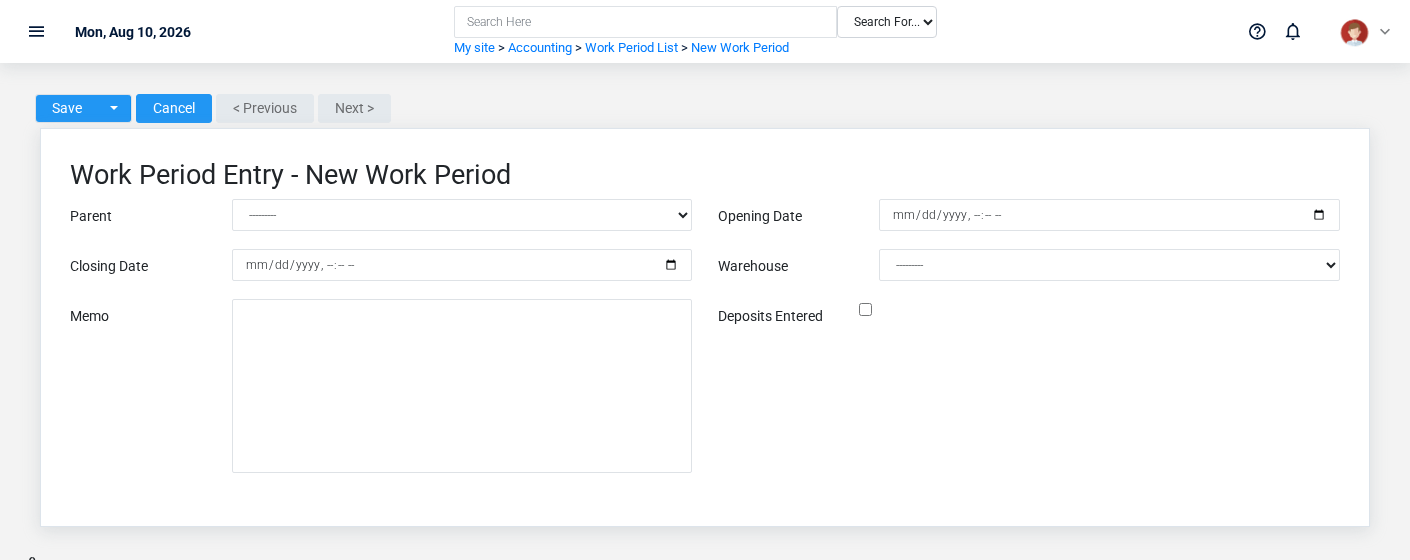
The Work Periods create screen in the Brisk documentation demo.
Create a Work Period after searching for the person, organization, item, location, or resource under alternate names and identifiers. Merge or correct an existing master record instead of creating a duplicate.
1. Select the business context first: **Parent**, and **Warehouse**.
2. Enter the required identifying and operational values: **Parent**, and **Opening Date**.
3. Review **Locked**, and **Deposits Entered** deliberately; these choices control availability or workflow rather than merely describing the record.
4. Save the Work Period, then confirm **Parent**, **Opening Date**, **Closing Date**, **Warehouse**, **Locked**, and **Memo**, plus the remaining screen fields on its detail page before continuing.
After saving: Verify this Work Period in **Deposits**, and **Work Period Overages/Shortages** before staff build new activity on it; correct ownership, classification, and active state now rather than after transactions accumulate.
Delete a Work Period
Delete this Work Period only if it is an unused duplicate or setup mistake. Once other records refer to it, preserve that history and make the value inactive when the screen provides that option.
Before confirming, check for related **Deposits**, and **Work Period Overages/Shortages**. Brisk may refuse deletion when another record depends on this one; resolve the duplicate or use the supported correction workflow instead of breaking the trail.
On the confirmation page, verify **Parent**, **Opening Date**, **Closing Date**, and **Warehouse**. After confirmation, return to the Work Periods list and make sure only the intended Work Period was removed.
Review Work Period details
Use the detail page as the shared record of what this Work Period currently means. Verify **Locked** before relying on it for a decision.
Follow **Parent**, and **Warehouse** to determine whether the issue is on this Work Period or on one of those linked records.
Next check: Verify this Work Period in **Deposits**, and **Work Period Overages/Shortages** before staff build new activity on it; correct ownership, classification, and active state now rather than after transactions accumulate.
Edit an existing Work Period
Edit this Work Period to keep the same real-world party, item, location, or resource accurate. Do not repurpose it for a different entity after activity is attached.
1. Open the detail page. Compare **Parent**, and **Warehouse** with the supporting document or approved request.
2. Recheck **Warehouse**, and **Locked**. These values are most likely to change account balances, financial periods, and statement results.
3. Save the change, return to the list, and confirm that the Work Period now appears under the expected **Locked**.
After the change: Verify this Work Period in **Deposits**, and **Work Period Overages/Shortages** before staff build new activity on it; correct ownership, classification, and active state now rather than after transactions accumulate.
Find and review work periods
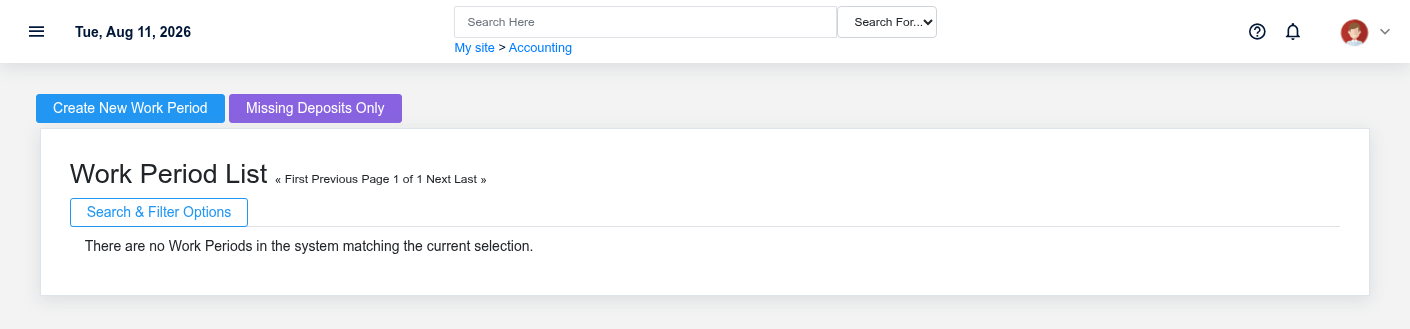
The Work Periods list screen in the Brisk documentation demo.
Use the Work Periods list to find the correct record before opening or changing it. Compare **Parent**, **Opening Date**, **Closing Date**, and **Warehouse**. Records with similar names or numbers can still belong to different **Parent**, and **Warehouse**.
- The initial order emphasizes **Opening Date**. Select a column heading when you need a different comparison.
Open the Work Period whose **Parent**, **Opening Date**, **Closing Date**, and **Warehouse** match the task. If it is missing, clear the list filters and recheck **Locked** rather than creating a replacement immediately.
## Fields and business rules
Brisk stores 7 user-relevant fields for this Work Period, including 2 linked-record selections and 0 controlled-choice fields. Create and edit screens may hide calculated or workflow-managed values from this full reference.
| Field | Required | What it controls |
|---|---:|---|
| **Parent** | Yes | Parent work period in the hierarchy. |
| **Opening Date** | Yes | Date and time recorded for opening date on this work period. |
| **Closing Date** | No | Date and time recorded for closing date on this work period. |
| **Warehouse** | No | Optionally scope this work period to a system warehouse. |
| **Locked** | No | Whether the locked option applies to this work period. |
| **Memo** | No | The memo recorded for this work period. |
| **Deposits Entered** | No | Indicates whether this work period has had deposits entered or not. |
## What happens next
Verify this Work Period in **Deposits**, and **Work Period Overages/Shortages** before staff build new activity on it; correct ownership, classification, and active state now rather than after transactions accumulate.
## Common mistakes and troubleshooting
- **The record will not save:** Recheck **Parent**, and **Opening Date** and any message beside the field. A required related record may also be inactive or unavailable to your role.
- **The record saved but is not available where expected:** Recheck **Locked**, then clear the filters on the destination list. A saved record can still be inactive, unpublished, locked, unapproved, or in the wrong workflow state.
- **The values look right but the result is wrong:** Open **Parent**, and **Warehouse** from the detail page. Correct the specific relationship that is wrong instead of forcing a total or status to compensate for it.