Maintain the standardized ways complaints or referrals enter the agency for consistent case reporting.
## At a glance
- **Identify it by:** **Name**.
- **Check its business context:** **Classification**.
- **Why care:** Use the agency’s approved terminology and access policy. Preserve dates, responsible personnel, case links, and audit history because these records may support official reporting or custody review.
## Before you begin
You need the Brisk permission for the action you are taking on complaint sources. If a Create, Edit, or Delete control is absent, do not work around it with another user’s account; ask an administrator to review your role.
Create a Complaint Source
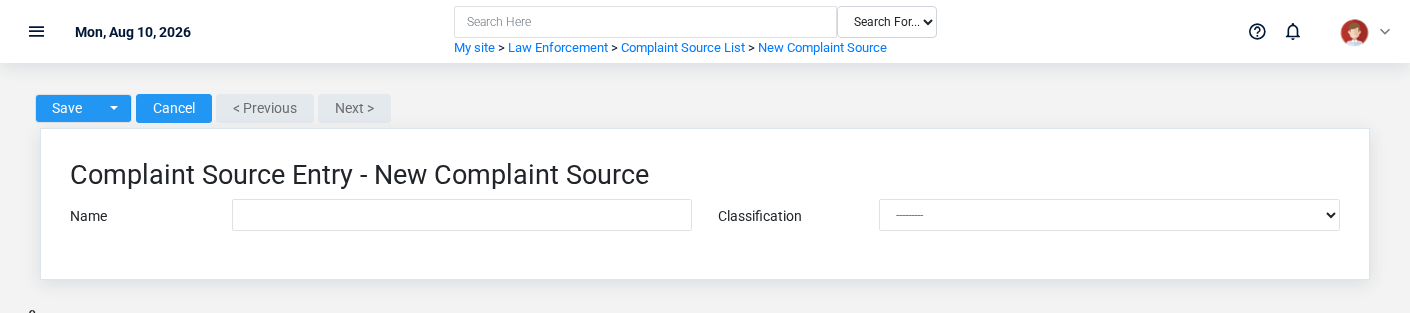
The Complaint Sources create screen in the Brisk documentation demo.
Create a Complaint Source only after confirming that the source document or operational event has not already been entered.
1. Select the business context first: **Classification**.
2. Enter the required identifying and operational values: **Name**.
3. Review the identifying information shown on the screen against the source document or approved setup decision.
4. Save the Complaint Source, then confirm **Name** on its detail page before continuing.
After saving: Verify **Classification** on the detail page, then continue the law enforcement workflow only when those values agree with the source document and actual work performed.
Delete a Complaint Source
Delete this Complaint Source only when it was entered by mistake and no downstream history depends on it. Use a reversal, void, credit, counter-adjustment, or status correction for a real event that later changed.
Before confirming, check for related **Activities**. Brisk may refuse deletion when another record depends on this one; resolve the duplicate or use the supported correction workflow instead of breaking the trail.
On the confirmation page, verify **Name**. After confirmation, return to the Complaint Sources list and make sure only the intended Complaint Source was removed.
Review Complaint Source details
Use the detail page as the shared record of what this Complaint Source currently means. Verify **Name**, and **Classification** before relying on it for a decision.
Follow **Classification** to determine whether the issue is on this Complaint Source or on one of those linked records.
Next check: Verify **Classification** on the detail page, then continue the law enforcement workflow only when those values agree with the source document and actual work performed.
Edit an existing Complaint Source
Edit this Complaint Source to correct or complete the same source document or operational event; use the supported reversal or follow-up workflow when the business event itself changed.
1. Open the detail page. Compare **Classification** with the supporting document or approved request.
2. Recheck the identifying information shown on the screen. These values are most likely to change case history, custody, dispatch, official reporting, or audit review.
3. Save the change, return to the list, and confirm that the Complaint Source now appears under the expected **Name**.
After the change: Verify **Classification** on the detail page, then continue the law enforcement workflow only when those values agree with the source document and actual work performed.
Find and review complaint sources
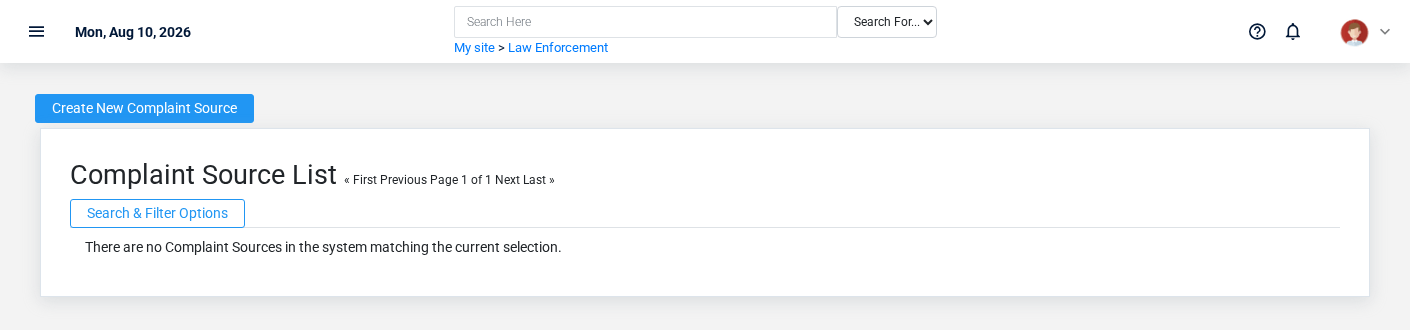
The Complaint Sources list screen in the Brisk documentation demo.
Use the Complaint Sources list to find the correct record before opening or changing it. Compare **Name**. Records with similar names or numbers can still belong to different **Classification**.
Open the Complaint Source whose **Name** match the task. If it is missing, clear the list filters and recheck the identifying information shown on the screen rather than creating a replacement immediately.
## Fields and business rules
Brisk stores 2 user-relevant fields for this Complaint Source, including 1 linked-record selection and 0 controlled-choice fields. Create and edit screens may hide calculated or workflow-managed values from this full reference.
| Field | Required | What it controls |
|---|---:|---|
| **Name** | Yes | Sets the name of this complaint source. |
| **Classification** | No | Optionally classify this complaint source for more in-depth reporting. |
## What happens next
Verify **Classification** on the detail page, then continue the law enforcement workflow only when those values agree with the source document and actual work performed.
## Common mistakes and troubleshooting
- **The record will not save:** Recheck **Name** and any message beside the field. A required related record may also be inactive or unavailable to your role.
- **The values look right but the result is wrong:** Open **Classification** from the detail page. Correct the specific relationship that is wrong instead of forcing a total or status to compensate for it.