Record alcohol-specific classifications, endorsements, dates, and conditions attached to a municipal license.
## At a glance
- **Identify it by:** **Permit Number**, **Authority**, **Issue Date**, and **Expiration Date**.
- **Check its business context:** **License**.
- **Why care:** Names, periods, classifications, due dates, status, charges, and payments form an official account history. Correct them from the supporting filing, application, receipt, or ordinance.
- **Why care:** Availability and publication flags affect future use without erasing history. Prefer disabling an obsolete setup record when existing transactions still refer to it.
## Before you begin
You need the Brisk permission for the action you are taking on alcohol license details. If a Create, Edit, or Delete control is absent, do not work around it with another user’s account; ask an administrator to review your role.
Have valid **License** records ready first. Those selections determine where this Alcohol License Detail belongs and which later screens can find it.
Create an Alcohol License Detail
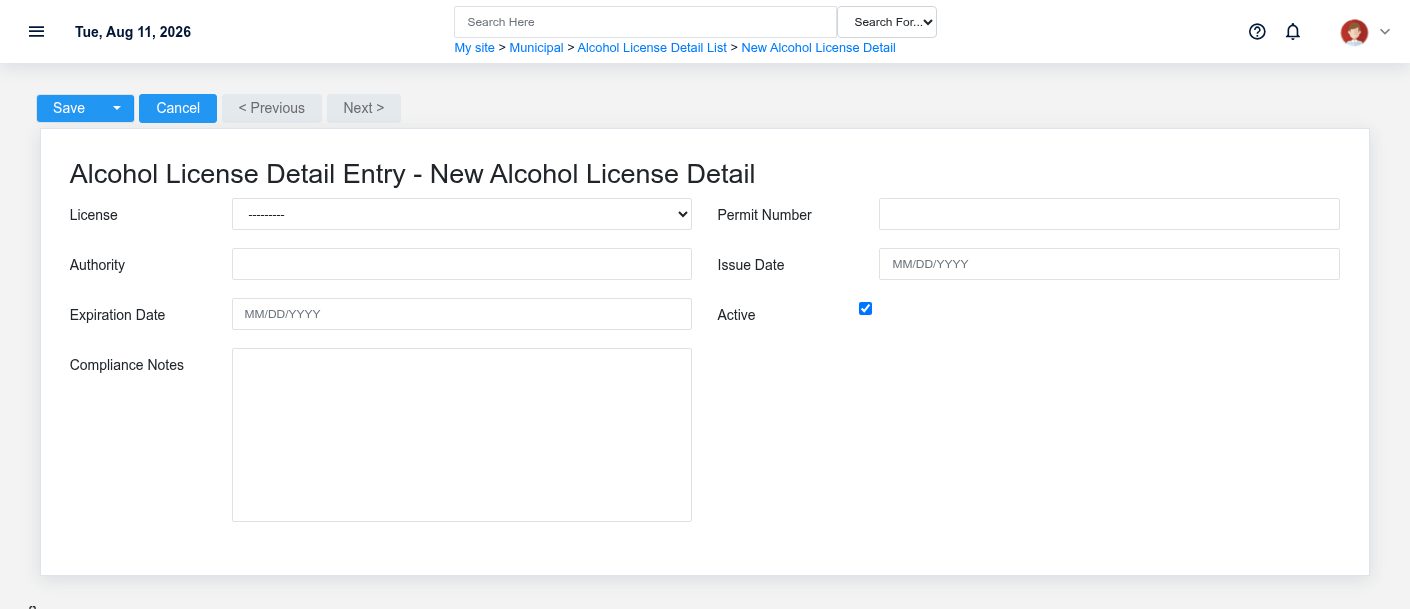
The Alcohol License Details create screen in the Brisk documentation demo.
Create an Alcohol License Detail only after confirming that the source document or operational event has not already been entered.
1. Select the business context first: **License**.
2. Enter the required identifying and operational values: **License**.
3. Review **Active** deliberately; these choices control availability or workflow rather than merely describing the record.
4. Save the Alcohol License Detail, then confirm **Permit Number**, **Authority**, **Issue Date**, and **Expiration Date** on its detail page before continuing.
After saving: Verify **Active**, and **License** on the detail page, then continue the municipal workflow only when those values agree with the source document and actual work performed.
Delete an Alcohol License Detail
Delete this Alcohol License Detail only when it was entered by mistake and no downstream history depends on it. Use a reversal, void, credit, counter-adjustment, or status correction for a real event that later changed.
If the record is merely obsolete, use **Active** to remove it from future use while preserving existing references.
On the confirmation page, verify **Permit Number**, **Authority**, **Issue Date**, and **Expiration Date**. After confirmation, return to the Alcohol License Details list and make sure only the intended Alcohol License Detail was removed.
Review Alcohol License Detail details
Use the detail page as the shared record of what this Alcohol License Detail currently means. Verify **Issue Date**, **Expiration Date**, and **Active** before relying on it for a decision.
Follow **License** to determine whether the issue is on this Alcohol License Detail or on one of those linked records.
Next check: Verify **Active**, and **License** on the detail page, then continue the municipal workflow only when those values agree with the source document and actual work performed.
Edit an existing Alcohol License Detail
Edit this Alcohol License Detail to correct or complete the same source document or operational event; use the supported reversal or follow-up workflow when the business event itself changed.
1. Open the detail page. Compare **License** with the supporting document or approved request.
2. Recheck **Issue Date**, **Expiration Date**, and **Active**. These values are most likely to change license, compliance, filing, charge, payment, and official account history.
3. Save the change, return to the list, and confirm that the Alcohol License Detail now appears under the expected **Active**.
After the change: Verify **Active**, and **License** on the detail page, then continue the municipal workflow only when those values agree with the source document and actual work performed.
Find and review alcohol license details
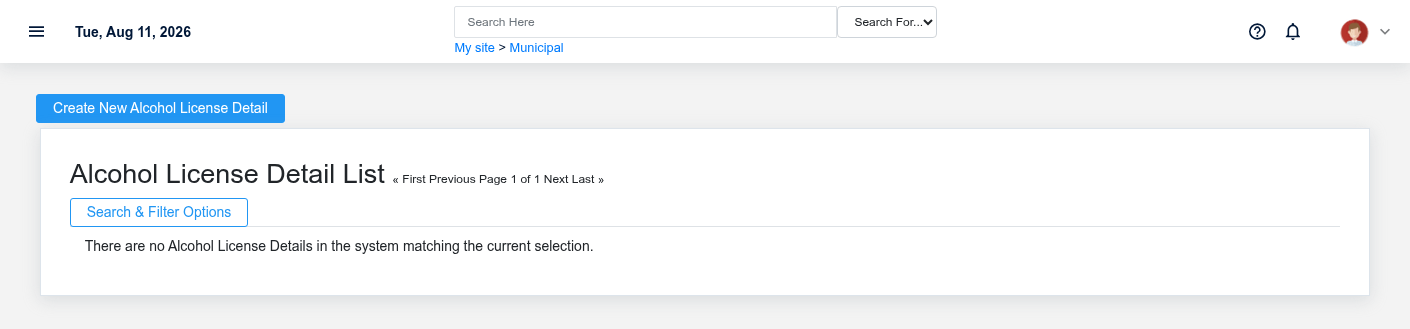
The Alcohol License Details list screen in the Brisk documentation demo.
Use the Alcohol License Details list to find the correct record before opening or changing it. Compare **Permit Number**, **Authority**, **Issue Date**, and **Expiration Date**. Records with similar names or numbers can still belong to different **License**.
- The initial order emphasizes **Expiration Date**, and **License Number**. Select a column heading when you need a different comparison.
Open the Alcohol License Detail whose **Permit Number**, **Authority**, **Issue Date**, and **Expiration Date** match the task. If it is missing, clear the list filters and recheck **Active** rather than creating a replacement immediately.
## Fields and business rules
Brisk stores 7 user-relevant fields for this Alcohol License Detail, including 1 linked-record selection and 0 controlled-choice fields. Create and edit screens may hide calculated or workflow-managed values from this full reference.
| Field | Required | What it controls |
|---|---:|---|
| **License** | Yes | The license associated with this alcohol license detail. |
| **Permit Number** | No | The permit number recorded for this alcohol license detail. |
| **Authority** | No | The authority recorded for this alcohol license detail. |
| **Issue Date** | No | Date recorded for issue date on this alcohol license detail. |
| **Expiration Date** | No | Date recorded for expiration date on this alcohol license detail. |
| **Active** | No | Whether this alcohol license detail is active and available for use. |
| **Compliance Notes** | No | The compliance notes recorded for this alcohol license detail. |
## What happens next
Verify **Active**, and **License** on the detail page, then continue the municipal workflow only when those values agree with the source document and actual work performed.
## Common mistakes and troubleshooting
- **The record will not save:** Recheck **License** and any message beside the field. A required related record may also be inactive or unavailable to your role.
- **The record saved but is not available where expected:** Recheck **Active**, then clear the filters on the destination list. A saved record can still be inactive, unpublished, locked, unapproved, or in the wrong workflow state.
- **The values look right but the result is wrong:** Open **License** from the detail page. Correct the specific relationship that is wrong instead of forcing a total or status to compensate for it.
# Business Classes
# Business Classes
Purpose and when to use this record
Maintain the classifications used to apply license, tax, fee, and reporting rules to municipal businesses.
## At a glance
- **Identify it by:** **Class**.
- **Why care:** Names, periods, classifications, due dates, status, charges, and payments form an official account history. Correct them from the supporting filing, application, receipt, or ordinance.
- **Why care:** Availability and publication flags affect future use without erasing history. Prefer disabling an obsolete setup record when existing transactions still refer to it.
## Before you begin
You need the Brisk permission for the action you are taking on business classes. If a Create, Edit, or Delete control is absent, do not work around it with another user’s account; ask an administrator to review your role.
Create a Business Class
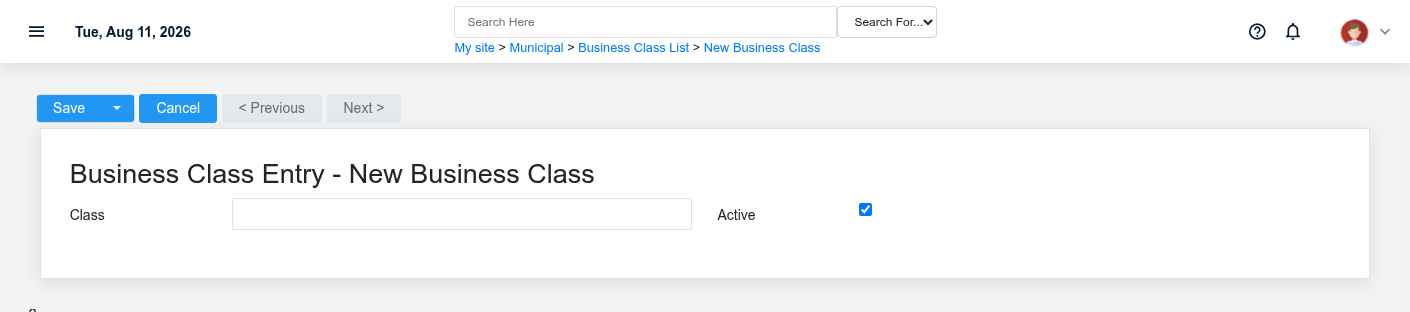
The Business Classes create screen in the Brisk documentation demo.
Create a Business Class only when the existing choices do not represent the policy or classification you need. Near-duplicate setup values split reporting and make later selection harder.
1. Select the business context first.
2. Enter the required identifying and operational values: **Class**.
3. Review **Active** deliberately; these choices control availability or workflow rather than merely describing the record.
4. Save the Business Class, then confirm **Class** on its detail page before continuing.
After saving: Open **Municipal Businesses** and confirm the Business Class appears with the intended label and availability. Keep the old value for historical records when changing it would split or relabel prior reporting.
Delete a Business Class
Delete this Business Class only if it is an unused duplicate or setup mistake. Once other records refer to it, preserve that history and make the value inactive when the screen provides that option.
If the record is merely obsolete, use **Active** to remove it from future use while preserving existing references.
Before confirming, check for related **Municipal Businesses**. Brisk may refuse deletion when another record depends on this one; resolve the duplicate or use the supported correction workflow instead of breaking the trail.
On the confirmation page, verify **Class**. After confirmation, return to the Business Classes list and make sure only the intended Business Class was removed.
Review Business Class details
Use the detail page as the shared record of what this Business Class currently means. Verify **Active** before relying on it for a decision.
Compare the Business Class with its source document or approved setup request before deciding that it needs correction.
Next check: Open **Municipal Businesses** and confirm the Business Class appears with the intended label and availability. Keep the old value for historical records when changing it would split or relabel prior reporting.
Edit an existing Business Class
Edit this Business Class when the underlying policy or classification changed. First determine whether historical transactions should retain the old value; if so, deactivate the old choice and create a new one.
1. Open the detail page. Compare **Class** with the supporting document or approved request.
2. Recheck **Active**. These values are most likely to change license, compliance, filing, charge, payment, and official account history.
3. Save the change, return to the list, and confirm that the Business Class now appears under the expected **Active**.
After the change: Open **Municipal Businesses** and confirm the Business Class appears with the intended label and availability. Keep the old value for historical records when changing it would split or relabel prior reporting.
Find and review business classes
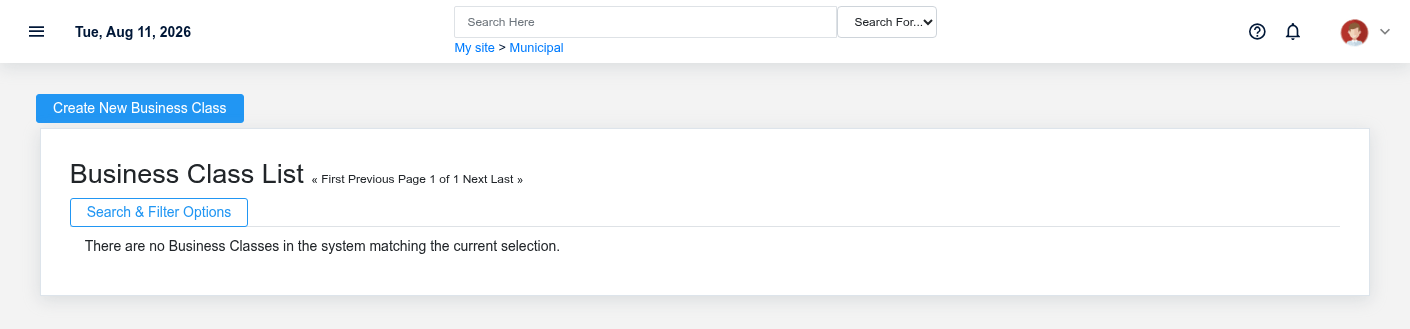
The Business Classes list screen in the Brisk documentation demo.
Use the Business Classes list to find the correct record before opening or changing it. Compare **Class**. Compare the full identifier rather than relying on a similar name.
- Keyword search checks **Class**.
- The initial order emphasizes **Class**. Select a column heading when you need a different comparison.
Open the Business Class whose **Class** match the task. If it is missing, clear the list filters and recheck **Active** rather than creating a replacement immediately.
## Fields and business rules
Brisk stores 2 user-relevant fields for this Business Class, including 0 linked-record selections and 0 controlled-choice fields. Create and edit screens may hide calculated or workflow-managed values from this full reference.
| Field | Required | What it controls |
|---|---:|---|
| **Class** | Yes | Human-readable name for this business class. |
| **Active** | No | Whether this business class is active and available for use. |
## What happens next
Open **Municipal Businesses** and confirm the Business Class appears with the intended label and availability. Keep the old value for historical records when changing it would split or relabel prior reporting.
## Common mistakes and troubleshooting
- **The record will not save:** Recheck **Class** and any message beside the field. A required related record may also be inactive or unavailable to your role.
- **The record saved but is not available where expected:** Recheck **Active**, then clear the filters on the destination list. A saved record can still be inactive, unpublished, locked, unapproved, or in the wrong workflow state.
- **The values look right but the result is wrong:** Compare this Business Class with the source document or approved setup decision, then check the downstream screen where it is used.
# Business License Payments
# Business License Payments
Purpose and when to use this record
Record money received against a business license and preserve its payer, amount, tender, and filing context.
## At a glance
- **Identify it by:** **Business License Number**, **Business Name**, **Date Paid**, **Effective Date**, and **Expire Date**.
- **Check its business context:** **Business**.
- **Why care:** Names, periods, classifications, due dates, status, charges, and payments form an official account history. Correct them from the supporting filing, application, receipt, or ordinance.
## Before you begin
You need the Brisk permission for the action you are taking on business license payments. If a Create, Edit, or Delete control is absent, do not work around it with another user’s account; ask an administrator to review your role.
Create a Business License Payment
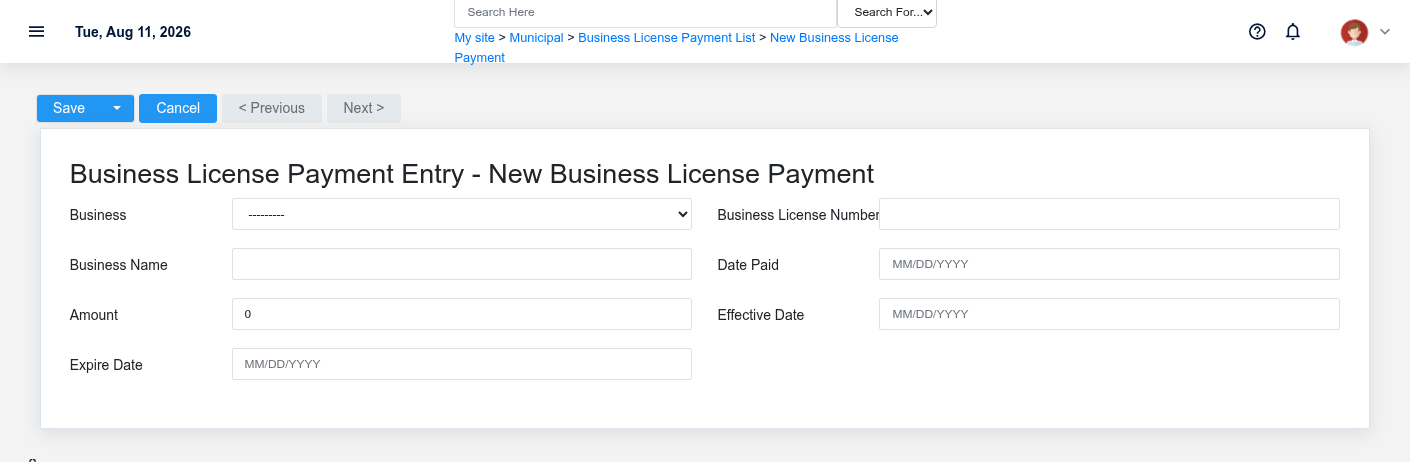
The Business License Payments create screen in the Brisk documentation demo.
Create a Business License Payment only after confirming that the source document or operational event has not already been entered.
1. Select the business context first: **Business**.
2. Enter the identifying values shown on the form, especially **Business**, **Business License Number**, **Business Name**, **Date Paid**, **Amount**, and **Effective Date**, plus the remaining screen fields.
3. Review **Business License Number**, **Business Name**, **Date Paid**, **Amount**, **Effective Date**, and **Expire Date** against the source document or approved setup decision.
4. Save the Business License Payment, then confirm **Business License Number**, **Business Name**, **Date Paid**, **Effective Date**, and **Expire Date** on its detail page before continuing.
After saving: Apply the receipt to the intended license balance and confirm the issued receipt, tender, and remaining amount agree.
Delete a Business License Payment
Delete this Business License Payment only when it was entered by mistake and no downstream history depends on it. Use a reversal, void, credit, counter-adjustment, or status correction for a real event that later changed.
On the confirmation page, verify **Business License Number**, **Business Name**, **Date Paid**, **Effective Date**, and **Expire Date**. After confirmation, return to the Business License Payments list and make sure only the intended Business License Payment was removed.
Review Business License Payment details
Use the detail page as the shared record of what this Business License Payment currently means. Verify **Date Paid**, **Amount**, **Effective Date**, and **Expire Date** before relying on it for a decision.
Follow **Business** to determine whether the issue is on this Business License Payment or on one of those linked records.
Next check: Apply the receipt to the intended license balance and confirm the issued receipt, tender, and remaining amount agree.
Edit an existing Business License Payment
Edit this Business License Payment to correct or complete the same source document or operational event; use the supported reversal or follow-up workflow when the business event itself changed.
1. Open the detail page. Compare **Business** with the supporting document or approved request.
2. Recheck **Date Paid**, **Amount**, **Effective Date**, and **Expire Date**. These values are most likely to change license, compliance, filing, charge, payment, and official account history.
3. Save the change, return to the list, and confirm that the Business License Payment now appears under the expected **Date Paid**.
After the change: Apply the receipt to the intended license balance and confirm the issued receipt, tender, and remaining amount agree.
Find and review business license payments
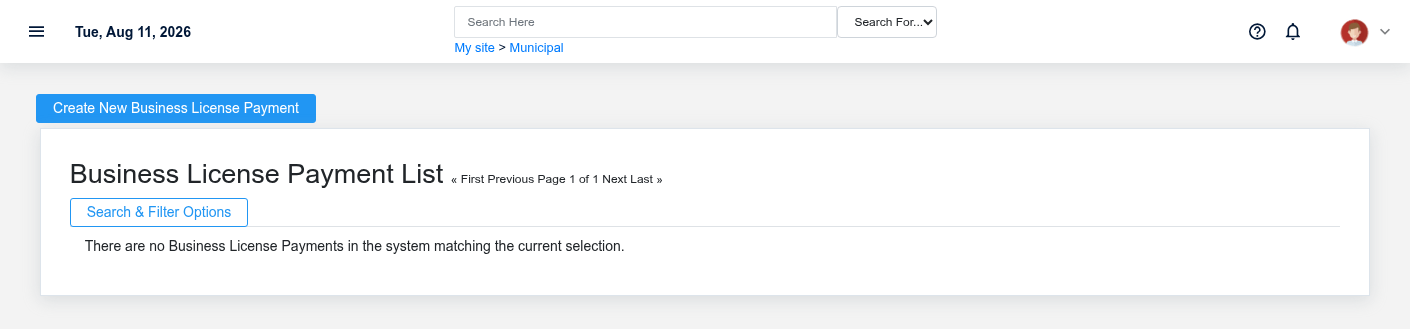
The Business License Payments list screen in the Brisk documentation demo.
Use the Business License Payments list to find the correct record before opening or changing it. Compare **Business License Number**, **Business Name**, **Date Paid**, **Effective Date**, and **Expire Date**. Records with similar names or numbers can still belong to different **Business**.
- Keyword search checks **Business Name**.
- The date filter uses **Expire Date**; choose a range that matches the business event you are reconciling.
- The initial order emphasizes **Expire Date**, and **Business Name**. Select a column heading when you need a different comparison.
Open the Business License Payment whose **Business License Number**, **Business Name**, **Date Paid**, **Effective Date**, and **Expire Date** match the task. If it is missing, clear the list filters and recheck **Expire Date**, and **Date Paid** rather than creating a replacement immediately.
## Fields and business rules
Brisk stores 7 user-relevant fields for this Business License Payment, including 1 linked-record selection and 0 controlled-choice fields. Create and edit screens may hide calculated or workflow-managed values from this full reference.
| Field | Required | What it controls |
|---|---:|---|
| **Business** | No | The business associated with this business license payment. |
| **Business License Number** | No | The business license number value recorded for this business license payment. |
| **Business Name** | No | The business name recorded for this business license payment. |
| **Date Paid** | No | Date recorded for date paid on this business license payment. |
| **Amount** | No | The amount value recorded for this business license payment. |
| **Effective Date** | No | Date recorded for effective date on this business license payment. |
| **Expire Date** | No | Date recorded for expire date on this business license payment. |
## What happens next
Apply the receipt to the intended license balance and confirm the issued receipt, tender, and remaining amount agree.
## Common mistakes and troubleshooting
- **The values look right but the result is wrong:** Open **Business** from the detail page. Correct the specific relationship that is wrong instead of forcing a total or status to compensate for it.
# Cemetery Plots
# Cemetery Plots
Purpose and when to use this record
Maintain an individual cemetery space, its location, availability, ownership, and burial history.
## At a glance
- **Identify it by:** **Plot Number**, and **Status**.
- **Check its business context:** **Cemetery**, and **Owner Account**.
- **Why care:** Names, periods, classifications, due dates, status, charges, and payments form an official account history. Correct them from the supporting filing, application, receipt, or ordinance.
- **Why care:** Status communicates workflow progress to other staff. Change it only when the underlying work, approval, payment, or handoff has actually occurred.
## Before you begin
You need the Brisk permission for the action you are taking on cemetery plots. If a Create, Edit, or Delete control is absent, do not work around it with another user’s account; ask an administrator to review your role.
Have valid **Cemetery** records ready first. Those selections determine where this Cemetery Plot belongs and which later screens can find it.
Create a Cemetery Plot
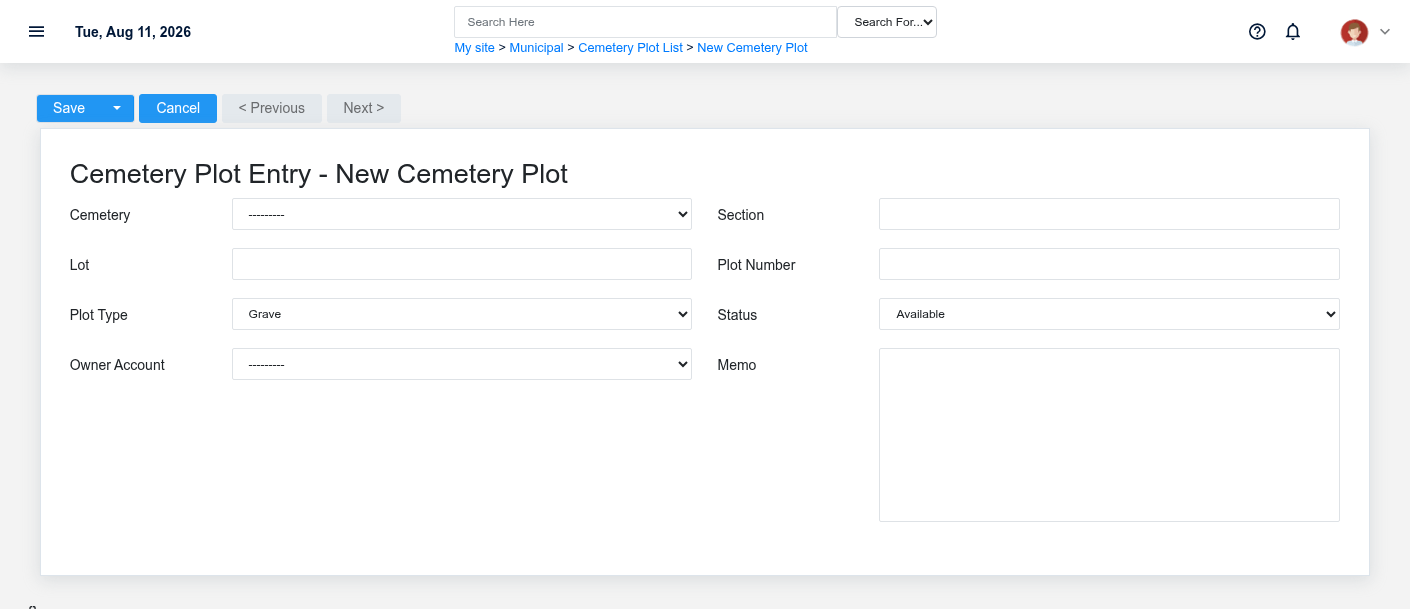
The Cemetery Plots create screen in the Brisk documentation demo.
Create a Cemetery Plot only after confirming that the source document or operational event has not already been entered.
1. Select the business context first: **Cemetery**, and **Owner Account**.
2. Enter the required identifying and operational values: **Cemetery**, and **Plot Number**.
3. Review **Plot Type**, and **Status** deliberately; these choices control availability or workflow rather than merely describing the record.
4. Save the Cemetery Plot, then confirm **Plot Number**, and **Status** on its detail page before continuing.
After saving: Verify **Plot Type**, **Status**, **Cemetery**, and **Owner Account** on the detail page, then continue the municipal workflow only when those values agree with the source document and actual work performed.
Delete a Cemetery Plot
Delete this Cemetery Plot only when it was entered by mistake and no downstream history depends on it. Use a reversal, void, credit, counter-adjustment, or status correction for a real event that later changed.
Before confirming, check for related **Interments**. Brisk may refuse deletion when another record depends on this one; resolve the duplicate or use the supported correction workflow instead of breaking the trail.
On the confirmation page, verify **Plot Number**, and **Status**. After confirmation, return to the Cemetery Plots list and make sure only the intended Cemetery Plot was removed.
Review Cemetery Plot details
Use the detail page as the shared record of what this Cemetery Plot currently means. Verify **Plot Type**, and **Status** before relying on it for a decision.
Follow **Cemetery**, and **Owner Account** to determine whether the issue is on this Cemetery Plot or on one of those linked records.
Next check: Verify **Plot Type**, **Status**, **Cemetery**, and **Owner Account** on the detail page, then continue the municipal workflow only when those values agree with the source document and actual work performed.
Edit an existing Cemetery Plot
Edit this Cemetery Plot to correct or complete the same source document or operational event; use the supported reversal or follow-up workflow when the business event itself changed.
1. Open the detail page. Compare **Cemetery**, and **Owner Account** with the supporting document or approved request.
2. Recheck **Plot Type**, **Status**, and **Owner Account**. These values are most likely to change license, compliance, filing, charge, payment, and official account history.
3. Save the change, return to the list, and confirm that the Cemetery Plot now appears under the expected **Plot Type**, and **Status**.
After the change: Verify **Plot Type**, **Status**, **Cemetery**, and **Owner Account** on the detail page, then continue the municipal workflow only when those values agree with the source document and actual work performed.
Find and review cemetery plots
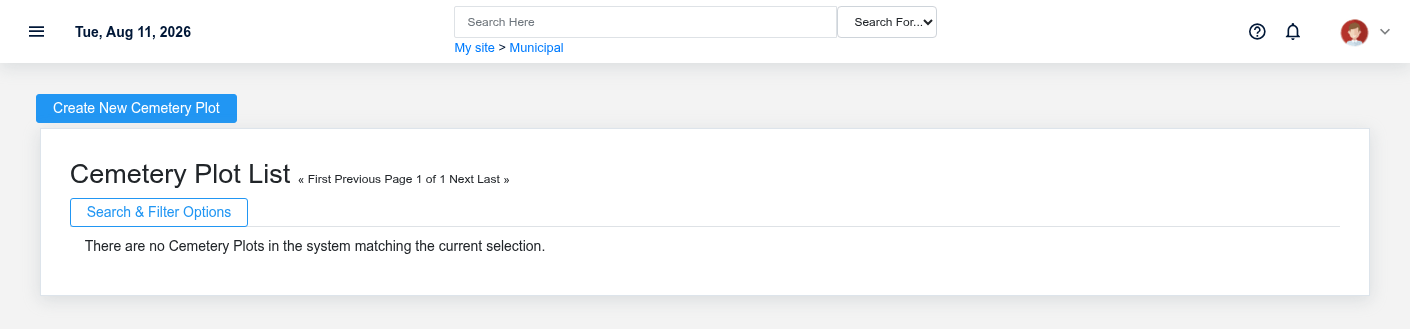
The Cemetery Plots list screen in the Brisk documentation demo.
Use the Cemetery Plots list to find the correct record before opening or changing it. Compare **Plot Number**, and **Status**. Records with similar names or numbers can still belong to different **Cemetery**, and **Owner Account**.
- The initial order emphasizes **Name**, **Section**, **Lot**, and **Plot Number**. Select a column heading when you need a different comparison.
Open the Cemetery Plot whose **Plot Number**, and **Status** match the task. If it is missing, clear the list filters and recheck **Plot Type**, and **Status** rather than creating a replacement immediately.
## Fields and business rules
Brisk stores 8 user-relevant fields for this Cemetery Plot, including 2 linked-record selections and 2 controlled-choice fields. Create and edit screens may hide calculated or workflow-managed values from this full reference.
| Field | Required | What it controls |
|---|---:|---|
| **Cemetery** | Yes | The cemetery associated with this cemetery plot. |
| **Section** | No | The section recorded for this cemetery plot. |
| **Lot** | No | The lot recorded for this cemetery plot. |
| **Plot Number** | Yes | The plot number recorded for this cemetery plot. |
| **Plot Type** | No | The plot type recorded for this cemetery plot. Available values: Grave, Mausoleum, Cremation, Columbarium. |
| **Status** | No | Current status of this cemetery plot. Available values: Available, Reserved, Occupied, Retired. |
| **Owner Account** | No | The owner account associated with this cemetery plot. |
| **Memo** | No | The memo recorded for this cemetery plot. |
## What happens next
Verify **Plot Type**, **Status**, **Cemetery**, and **Owner Account** on the detail page, then continue the municipal workflow only when those values agree with the source document and actual work performed.
## Common mistakes and troubleshooting
- **The record will not save:** Recheck **Cemetery**, and **Plot Number** and any message beside the field. A required related record may also be inactive or unavailable to your role.
- **The record saved but is not available where expected:** Recheck **Plot Type**, and **Status**, then clear the filters on the destination list. A saved record can still be inactive, unpublished, locked, unapproved, or in the wrong workflow state.
- **The values look right but the result is wrong:** Open **Cemetery**, and **Owner Account** from the detail page. Correct the specific relationship that is wrong instead of forcing a total or status to compensate for it.
# Cemeteries
# Cemeteries
Purpose and when to use this record
Maintain municipal cemetery locations used to organize plots, ownership, availability, and interments.
## At a glance
- **Identify it by:** **Name**, **Code**, and **Postal Code**.
- **Why care:** Names, periods, classifications, due dates, status, charges, and payments form an official account history. Correct them from the supporting filing, application, receipt, or ordinance.
- **Why care:** Availability and publication flags affect future use without erasing history. Prefer disabling an obsolete setup record when existing transactions still refer to it.
## Before you begin
You need the Brisk permission for the action you are taking on cemeteries. If a Create, Edit, or Delete control is absent, do not work around it with another user’s account; ask an administrator to review your role.
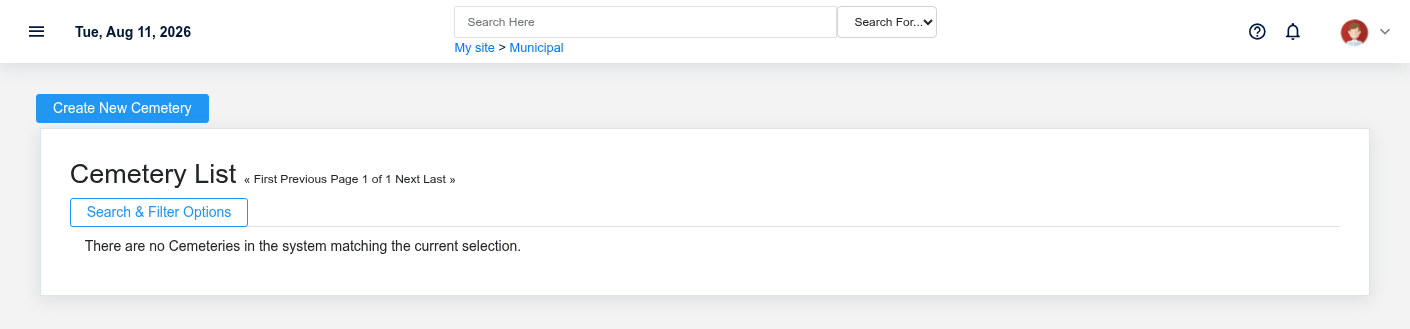
Find and review cemeteries
The Cemeteries list screen in the Brisk documentation demo.
Use the Cemeteries list to find the correct record before opening or changing it. Compare **Name**, **Code**, and **Postal Code**. Compare the full identifier rather than relying on a similar name.
- The initial order emphasizes **Name**. Select a column heading when you need a different comparison.
Open the Cemetery whose **Name**, **Code**, and **Postal Code** match the task. If it is missing, clear the list filters and recheck **Active** rather than creating a replacement immediately.
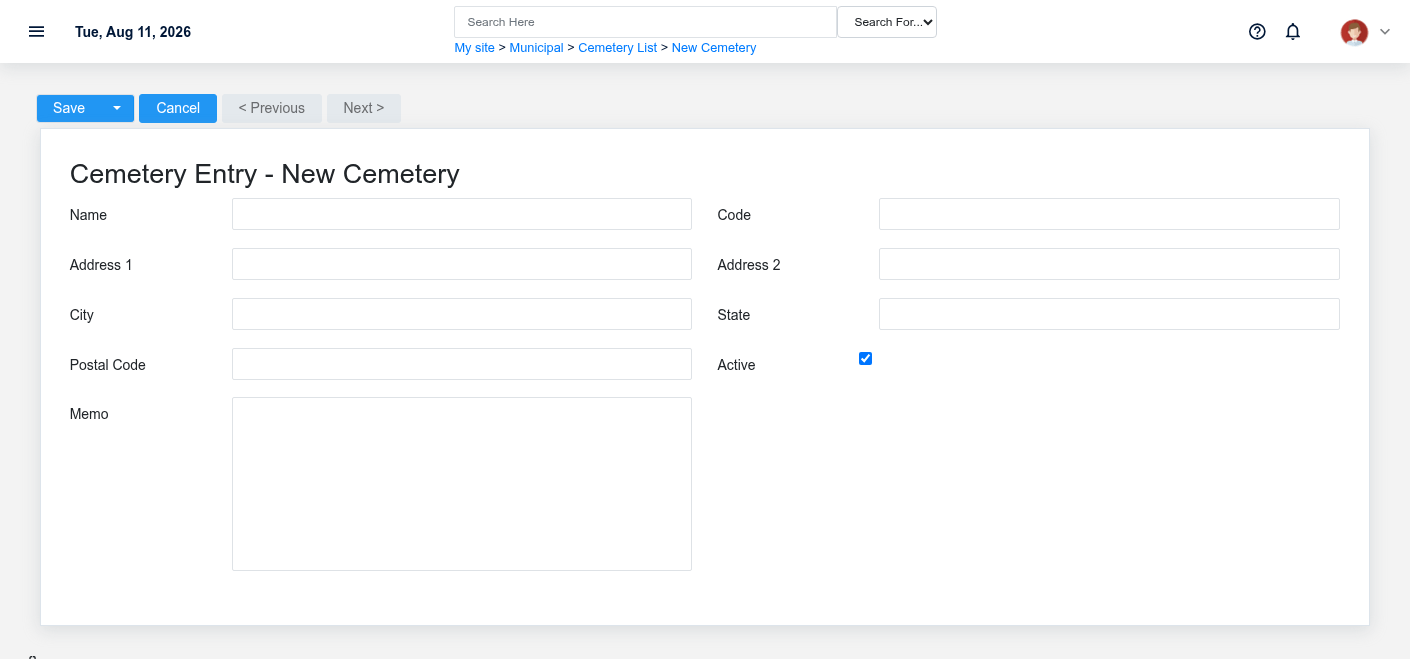
Create a Cemetery
The Cemeteries create screen in the Brisk documentation demo.
Create a Cemetery only after confirming that the source document or operational event has not already been entered.
1. Select the business context first.
2. Enter the required identifying and operational values: **Name**.
3. Review **Active** deliberately; these choices control availability or workflow rather than merely describing the record.
4. Save the Cemetery, then confirm **Name**, **Code**, and **Postal Code** on its detail page before continuing.
After saving: Verify **Active** on the detail page, then continue the municipal workflow only when those values agree with the source document and actual work performed.
Delete a Cemetery
Delete this Cemetery only when it was entered by mistake and no downstream history depends on it. Use a reversal, void, credit, counter-adjustment, or status correction for a real event that later changed.
If the record is merely obsolete, use **Active** to remove it from future use while preserving existing references.
Before confirming, check for related **Cemetery Plots**. Brisk may refuse deletion when another record depends on this one; resolve the duplicate or use the supported correction workflow instead of breaking the trail.
On the confirmation page, verify **Name**, **Code**, and **Postal Code**. After confirmation, return to the Cemeteries list and make sure only the intended Cemetery was removed.
Review Cemetery details
Use the detail page as the shared record of what this Cemetery currently means. Verify **Active** before relying on it for a decision.
Compare the Cemetery with its source document or approved setup request before deciding that it needs correction.
Next check: Verify **Active** on the detail page, then continue the municipal workflow only when those values agree with the source document and actual work performed.
Edit an existing Cemetery
Edit this Cemetery to correct or complete the same source document or operational event; use the supported reversal or follow-up workflow when the business event itself changed.
1. Open the detail page. Compare **Name**, **Code**, and **Postal Code** with the supporting document or approved request.
2. Recheck **Active**. These values are most likely to change license, compliance, filing, charge, payment, and official account history.
3. Save the change, return to the list, and confirm that the Cemetery now appears under the expected **Active**.
After the change: Verify **Active** on the detail page, then continue the municipal workflow only when those values agree with the source document and actual work performed.
## Fields and business rules
Brisk stores 9 user-relevant fields for this Cemetery, including 0 linked-record selections and 0 controlled-choice fields. Create and edit screens may hide calculated or workflow-managed values from this full reference.
| Field | Required | What it controls |
|---|---:|---|
| **Name** | Yes | Human-readable name for this cemetery. |
| **Code** | No | Short code used to identify this cemetery. |
| **Address 1** | No | The address 1 recorded for this cemetery. |
| **Address 2** | No | The address 2 recorded for this cemetery. |
| **City** | No | The city recorded for this cemetery. |
| **State** | No | The state recorded for this cemetery. |
| **Postal Code** | No | The postal code recorded for this cemetery. |
| **Active** | No | Whether this cemetery is active and available for use. |
| **Memo** | No | The memo recorded for this cemetery. |
## What happens next
Verify **Active** on the detail page, then continue the municipal workflow only when those values agree with the source document and actual work performed.
## Common mistakes and troubleshooting
- **The record will not save:** Recheck **Name** and any message beside the field. A required related record may also be inactive or unavailable to your role.
- **The record saved but is not available where expected:** Recheck **Active**, then clear the filters on the destination list. A saved record can still be inactive, unpublished, locked, unapproved, or in the wrong workflow state.
- **The values look right but the result is wrong:** Compare this Cemetery with the source document or approved setup decision, then check the downstream screen where it is used.
# Compliance Tasks
# Compliance Tasks
Purpose and when to use this record
Assign and track an inspection, document, renewal, or follow-up obligation for a municipal business or license.
## At a glance
- **Identify it by:** **Due Date**, and **Status**.
- **Check its business context:** **Account**, **License**, **Application**, and **Assigned To**.
- **Why care:** Names, periods, classifications, due dates, status, charges, and payments form an official account history. Correct them from the supporting filing, application, receipt, or ordinance.
- **Why care:** Status communicates workflow progress to other staff. Change it only when the underlying work, approval, payment, or handoff has actually occurred.
## Before you begin
You need the Brisk permission for the action you are taking on compliance tasks. If a Create, Edit, or Delete control is absent, do not work around it with another user’s account; ask an administrator to review your role.
Have valid **Account** records ready first. Those selections determine where this Compliance Task belongs and which later screens can find it.
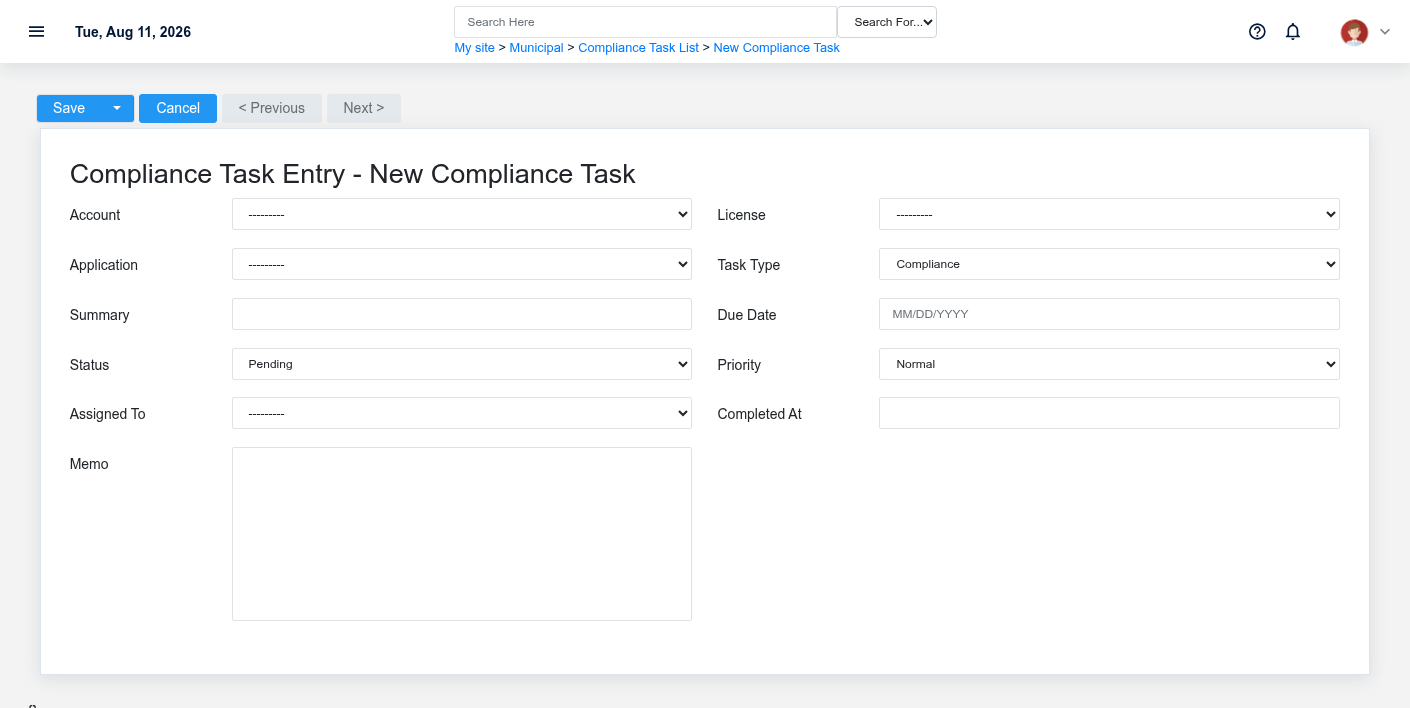
Create a Compliance Task
The Compliance Tasks create screen in the Brisk documentation demo.
Create a Compliance Task only after confirming that the source document or operational event has not already been entered.
1. Select the business context first: **Account**, **License**, **Application**, and **Assigned To**.
2. Enter the required identifying and operational values: **Account**, and **Summary**.
3. Review **Task Type**, **Status**, and **Priority** deliberately; these choices control availability or workflow rather than merely describing the record.
4. Save the Compliance Task, then confirm **Due Date**, and **Status** on its detail page before continuing.
After saving: Verify **Task Type**, **Status**, **Priority**, **Account**, **License**, and **Application**, plus the remaining screen fields on the detail page, then continue the municipal workflow only when those values agree with the source document and actual work performed.
Delete a Compliance Task
Delete this Compliance Task only when it was entered by mistake and no downstream history depends on it. Use a reversal, void, credit, counter-adjustment, or status correction for a real event that later changed.
On the confirmation page, verify **Due Date**, and **Status**. After confirmation, return to the Compliance Tasks list and make sure only the intended Compliance Task was removed.
Review Compliance Task details
Use the detail page as the shared record of what this Compliance Task currently means. Verify **Task Type**, **Due Date**, **Status**, and **Priority** before relying on it for a decision.
Follow **Account**, **License**, **Application**, and **Assigned To** to determine whether the issue is on this Compliance Task or on one of those linked records.
Next check: Verify **Task Type**, **Status**, **Priority**, **Account**, **License**, and **Application**, plus the remaining screen fields on the detail page, then continue the municipal workflow only when those values agree with the source document and actual work performed.
Edit an existing Compliance Task
Edit this Compliance Task to correct or complete the same source document or operational event; use the supported reversal or follow-up workflow when the business event itself changed.
1. Open the detail page. Compare **Account**, **License**, **Application**, and **Assigned To** with the supporting document or approved request.
2. Recheck **Account**, **Task Type**, **Due Date**, **Status**, and **Priority**. These values are most likely to change license, compliance, filing, charge, payment, and official account history.
3. Save the change, return to the list, and confirm that the Compliance Task now appears under the expected **Task Type**, **Status**, and **Priority**.
After the change: Verify **Task Type**, **Status**, **Priority**, **Account**, **License**, and **Application**, plus the remaining screen fields on the detail page, then continue the municipal workflow only when those values agree with the source document and actual work performed.
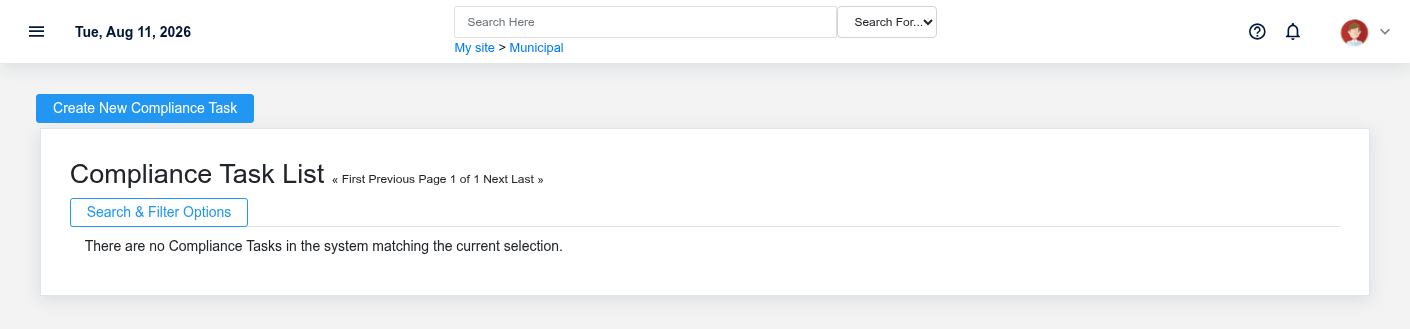
Find and review compliance tasks
The Compliance Tasks list screen in the Brisk documentation demo.
Use the Compliance Tasks list to find the correct record before opening or changing it. Compare **Due Date**, and **Status**. Records with similar names or numbers can still belong to different **Account**, **License**, **Application**, and **Assigned To**.
- The initial order emphasizes **Status**, **Due Date**, and **Priority**. Select a column heading when you need a different comparison.
Open the Compliance Task whose **Due Date**, and **Status** match the task. If it is missing, clear the list filters and recheck **Task Type**, **Status**, and **Priority** rather than creating a replacement immediately.
## Fields and business rules
Brisk stores 11 user-relevant fields for this Compliance Task, including 4 linked-record selections and 3 controlled-choice fields. Create and edit screens may hide calculated or workflow-managed values from this full reference.
| Field | Required | What it controls |
|---|---:|---|
| **Account** | Yes | The account associated with this compliance task. |
| **License** | No | The license associated with this compliance task. |
| **Application** | No | The application associated with this compliance task. |
| **Task Type** | No | The task type recorded for this compliance task. Available values: Renewal, Compliance, Inspection, Follow-Up. |
| **Summary** | Yes | The summary recorded for this compliance task. |
| **Due Date** | No | Date recorded for due date on this compliance task. |
| **Status** | No | Current status of this compliance task. Available values: Pending, In Progress, Completed, Cancelled. |
| **Priority** | No | The priority recorded for this compliance task. Available values: Low, Normal, High. |
| **Assigned To** | No | The assigned to associated with this compliance task. |
| **Completed At** | No | Date and time recorded for completed at on this compliance task. |
| **Memo** | No | The memo recorded for this compliance task. |
## What happens next
Verify **Task Type**, **Status**, **Priority**, **Account**, **License**, and **Application**, plus the remaining screen fields on the detail page, then continue the municipal workflow only when those values agree with the source document and actual work performed.
## Common mistakes and troubleshooting
- **The record will not save:** Recheck **Account**, and **Summary** and any message beside the field. A required related record may also be inactive or unavailable to your role.
- **The record saved but is not available where expected:** Recheck **Task Type**, **Status**, and **Priority**, then clear the filters on the destination list. A saved record can still be inactive, unpublished, locked, unapproved, or in the wrong workflow state.
- **The values look right but the result is wrong:** Open **Account**, **License**, **Application**, and **Assigned To** from the detail page. Correct the specific relationship that is wrong instead of forcing a total or status to compensate for it.
# Interments
# Interments
Purpose and when to use this record
Record a burial or placement in a specific cemetery plot with the decedent and service details needed for the permanent record.
## At a glance
- **Identify it by:** **Deceased Name**, **Birth Date**, **Death Date**, **Interment Date**, and **Permit Number**.
- **Check its business context:** **Plot**, and **Next Of Kin Account**.
- **Why care:** Names, periods, classifications, due dates, status, charges, and payments form an official account history. Correct them from the supporting filing, application, receipt, or ordinance.
## Before you begin
You need the Brisk permission for the action you are taking on interments. If a Create, Edit, or Delete control is absent, do not work around it with another user’s account; ask an administrator to review your role.
Have valid **Plot** records ready first. Those selections determine where this Interment belongs and which later screens can find it.
Create an Interment
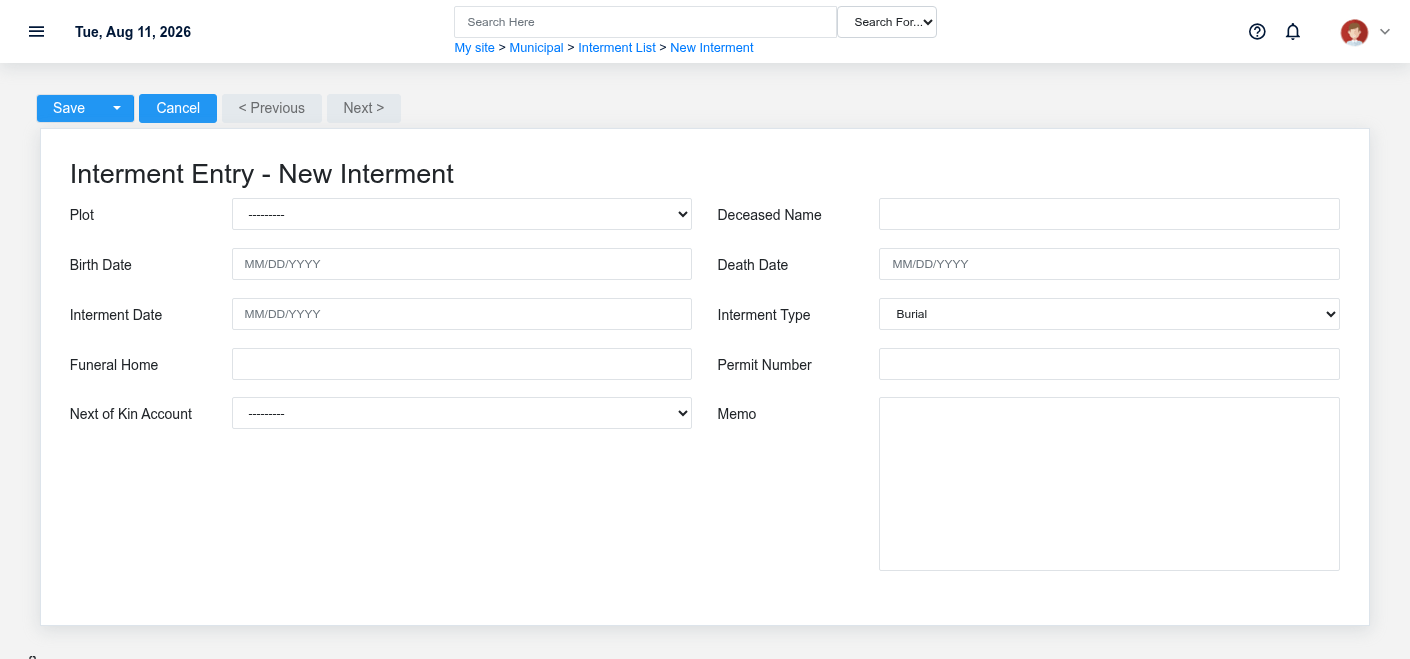
The Interments create screen in the Brisk documentation demo.
Create an Interment only after confirming that the source document or operational event has not already been entered.
1. Select the business context first: **Plot**, and **Next Of Kin Account**.
2. Enter the required identifying and operational values: **Plot**, and **Deceased Name**.
3. Review **Interment Type** deliberately; these choices control availability or workflow rather than merely describing the record.
4. Save the Interment, then confirm **Deceased Name**, **Birth Date**, **Death Date**, **Interment Date**, and **Permit Number** on its detail page before continuing.
After saving: Verify **Interment Type**, **Plot**, and **Next Of Kin Account** on the detail page, then continue the municipal workflow only when those values agree with the source document and actual work performed.
Delete an Interment
Delete this Interment only when it was entered by mistake and no downstream history depends on it. Use a reversal, void, credit, counter-adjustment, or status correction for a real event that later changed.
On the confirmation page, verify **Deceased Name**, **Birth Date**, **Death Date**, **Interment Date**, and **Permit Number**. After confirmation, return to the Interments list and make sure only the intended Interment was removed.
Review Interment details
Use the detail page as the shared record of what this Interment currently means. Verify **Birth Date**, **Death Date**, **Interment Date**, and **Interment Type** before relying on it for a decision.
Follow **Plot**, and **Next Of Kin Account** to determine whether the issue is on this Interment or on one of those linked records.
Next check: Verify **Interment Type**, **Plot**, and **Next Of Kin Account** on the detail page, then continue the municipal workflow only when those values agree with the source document and actual work performed.
Edit an existing Interment
Edit this Interment to correct or complete the same source document or operational event; use the supported reversal or follow-up workflow when the business event itself changed.
1. Open the detail page. Compare **Plot**, and **Next Of Kin Account** with the supporting document or approved request.
2. Recheck **Birth Date**, **Death Date**, **Interment Date**, **Interment Type**, and **Next Of Kin Account**. These values are most likely to change license, compliance, filing, charge, payment, and official account history.
3. Save the change, return to the list, and confirm that the Interment now appears under the expected **Interment Type**.
After the change: Verify **Interment Type**, **Plot**, and **Next Of Kin Account** on the detail page, then continue the municipal workflow only when those values agree with the source document and actual work performed.
Find and review interments
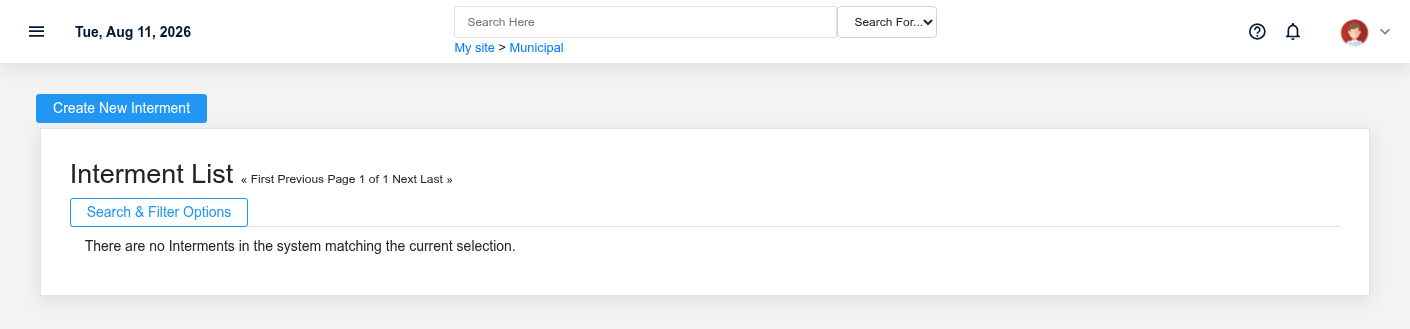
The Interments list screen in the Brisk documentation demo.
Use the Interments list to find the correct record before opening or changing it. Compare **Deceased Name**, **Birth Date**, **Death Date**, **Interment Date**, and **Permit Number**. Records with similar names or numbers can still belong to different **Plot**, and **Next Of Kin Account**.
- The initial order emphasizes **Interment Date**, and **Id**. Select a column heading when you need a different comparison.
Open the Interment whose **Deceased Name**, **Birth Date**, **Death Date**, **Interment Date**, and **Permit Number** match the task. If it is missing, clear the list filters and recheck **Interment Type** rather than creating a replacement immediately.
## Fields and business rules
Brisk stores 10 user-relevant fields for this Interment, including 2 linked-record selections and 1 controlled-choice field. Create and edit screens may hide calculated or workflow-managed values from this full reference.
| Field | Required | What it controls |
|---|---:|---|
| **Plot** | Yes | The plot associated with this interment. |
| **Deceased Name** | Yes | The deceased name recorded for this interment. |
| **Birth Date** | No | Date recorded for birth date on this interment. |
| **Death Date** | No | Date recorded for death date on this interment. |
| **Interment Date** | No | Date recorded for interment date on this interment. |
| **Interment Type** | No | The interment type recorded for this interment. Available values: Burial, Cremains. |
| **Funeral Home** | No | The funeral home recorded for this interment. |
| **Permit Number** | No | The permit number recorded for this interment. |
| **Next Of Kin Account** | No | The next of kin account associated with this interment. |
| **Memo** | No | The memo recorded for this interment. |
## What happens next
Verify **Interment Type**, **Plot**, and **Next Of Kin Account** on the detail page, then continue the municipal workflow only when those values agree with the source document and actual work performed.
## Common mistakes and troubleshooting
- **The record will not save:** Recheck **Plot**, and **Deceased Name** and any message beside the field. A required related record may also be inactive or unavailable to your role.
- **The values look right but the result is wrong:** Open **Plot**, and **Next Of Kin Account** from the detail page. Correct the specific relationship that is wrong instead of forcing a total or status to compensate for it.
# License Applications
# License Applications
Purpose and when to use this record
Receive and review a business’s request for a municipal license before approval, rejection, or conversion to an issued license.
## At a glance
- **Identify it by:** **Application Number**, **Status**, **Submitted Date**, **Requested Effective Date**, and **Review Due Date**.
- **Check its business context:** **Account**, **License Type**, and **Reviewed By**.
- **Why care:** Names, periods, classifications, due dates, status, charges, and payments form an official account history. Correct them from the supporting filing, application, receipt, or ordinance.
- **Why care:** Status communicates workflow progress to other staff. Change it only when the underlying work, approval, payment, or handoff has actually occurred.
## Before you begin
You need the Brisk permission for the action you are taking on license applications. If a Create, Edit, or Delete control is absent, do not work around it with another user’s account; ask an administrator to review your role.
Have valid **Account**, and **License Type** records ready first. Those selections determine where this License Application belongs and which later screens can find it.
Create a License Application
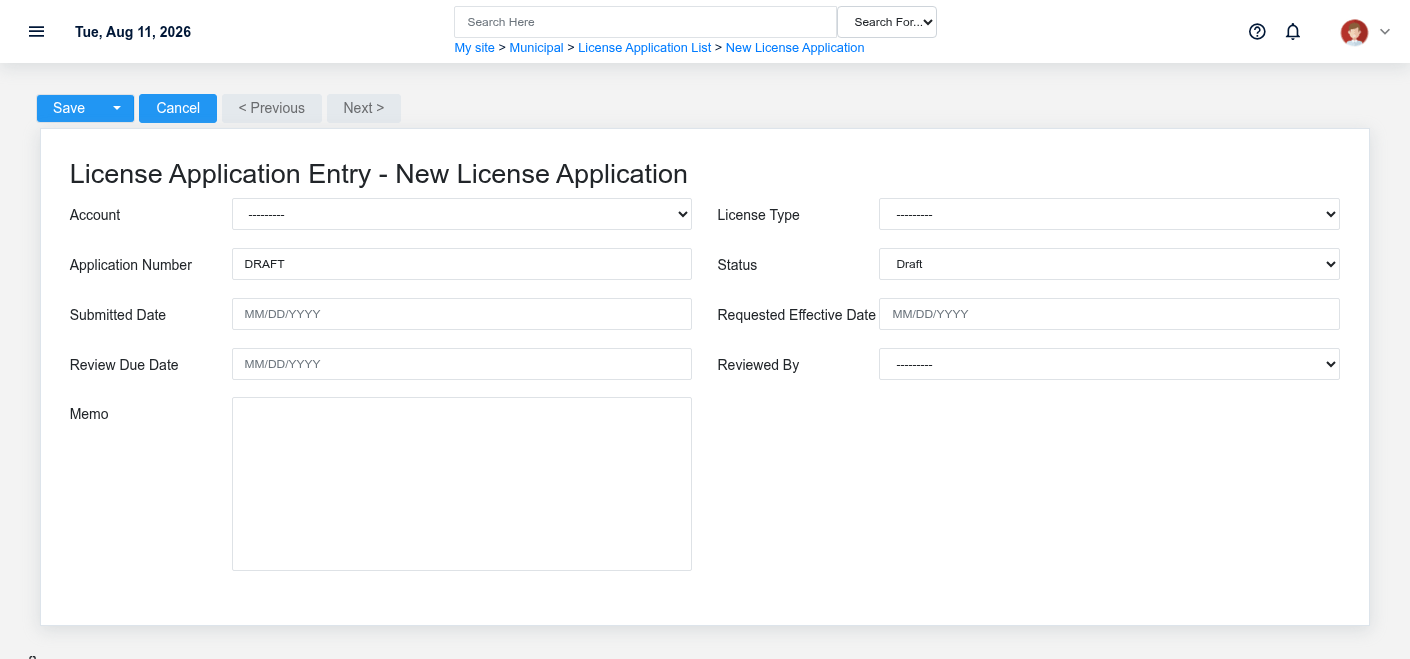
The License Applications create screen in the Brisk documentation demo.
Create a License Application only after confirming that the source document or operational event has not already been entered.
1. Select the business context first: **Account**, **License Type**, and **Reviewed By**.
2. Enter the required identifying and operational values: **Account**, **License Type**, and **Application Number**.
3. Review **Status** deliberately; these choices control availability or workflow rather than merely describing the record.
4. Save the License Application, then confirm **Application Number**, **Status**, **Submitted Date**, **Requested Effective Date**, and **Review Due Date** on its detail page before continuing.
After saving: Complete the required review and fees before approval; an approved application should lead to the correct issued license rather than a duplicate business record.
Delete a License Application
Delete this License Application only when it was entered by mistake and no downstream history depends on it. Use a reversal, void, credit, counter-adjustment, or status correction for a real event that later changed.
Before confirming, check for related **Compliance Tasks**, **Licenses**, and **Municipal Charges**. Brisk may refuse deletion when another record depends on this one; resolve the duplicate or use the supported correction workflow instead of breaking the trail.
On the confirmation page, verify **Application Number**, **Status**, **Submitted Date**, **Requested Effective Date**, and **Review Due Date**. After confirmation, return to the License Applications list and make sure only the intended License Application was removed.
Review License Application details
Use the detail page as the shared record of what this License Application currently means. Verify **Status**, **Submitted Date**, **Requested Effective Date**, and **Review Due Date** before relying on it for a decision.
Follow **Account**, **License Type**, and **Reviewed By** to determine whether the issue is on this License Application or on one of those linked records.
Next check: Complete the required review and fees before approval; an approved application should lead to the correct issued license rather than a duplicate business record.
Edit an existing License Application
Edit this License Application to correct or complete the same source document or operational event; use the supported reversal or follow-up workflow when the business event itself changed.
1. Open the detail page. Compare **Account**, **License Type**, and **Reviewed By** with the supporting document or approved request.
2. Recheck **Account**, **Status**, **Submitted Date**, **Requested Effective Date**, and **Review Due Date**. These values are most likely to change license, compliance, filing, charge, payment, and official account history.
3. Save the change, return to the list, and confirm that the License Application now appears under the expected **Status**.
After the change: Complete the required review and fees before approval; an approved application should lead to the correct issued license rather than a duplicate business record.
Find and review license applications
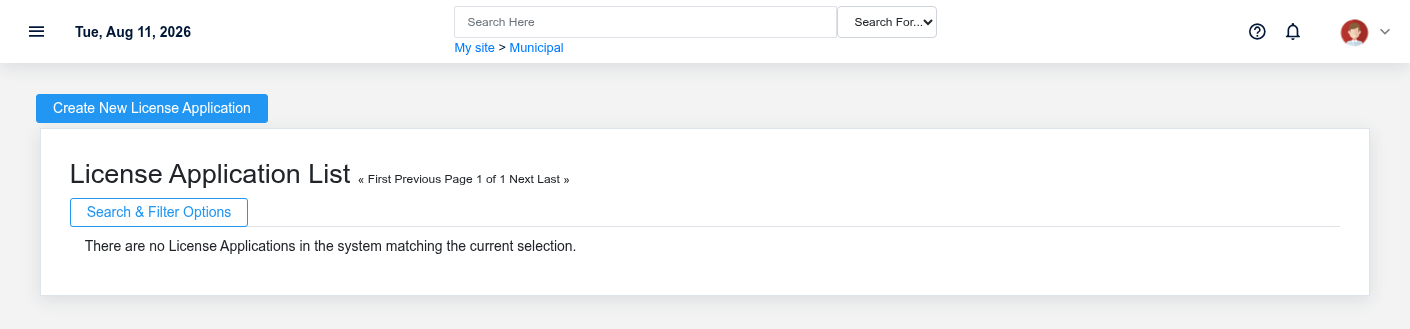
The License Applications list screen in the Brisk documentation demo.
Use the License Applications list to find the correct record before opening or changing it. Compare **Application Number**, **Status**, **Submitted Date**, **Requested Effective Date**, and **Review Due Date**. Records with similar names or numbers can still belong to different **Account**, **License Type**, and **Reviewed By**.
- The initial order emphasizes **Submitted Date**, and **Id**. Select a column heading when you need a different comparison.
Open the License Application whose **Application Number**, **Status**, **Submitted Date**, **Requested Effective Date**, and **Review Due Date** match the task. If it is missing, clear the list filters and recheck **Status** rather than creating a replacement immediately.
## Fields and business rules
Brisk stores 9 user-relevant fields for this License Application, including 3 linked-record selections and 1 controlled-choice field. Create and edit screens may hide calculated or workflow-managed values from this full reference.
| Field | Required | What it controls |
|---|---:|---|
| **Account** | Yes | The account associated with this license application. |
| **License Type** | Yes | The license type associated with this license application. |
| **Application Number** | Yes | The application number recorded for this license application. |
| **Status** | No | Current status of this license application. Available values: Draft, Submitted, In Review, Approved, Denied, Converted. |
| **Submitted Date** | No | Date recorded for submitted date on this license application. |
| **Requested Effective Date** | No | Date recorded for requested effective date on this license application. |
| **Review Due Date** | No | Date recorded for review due date on this license application. |
| **Reviewed By** | No | The reviewed by associated with this license application. |
| **Memo** | No | The memo recorded for this license application. |
## What happens next
Complete the required review and fees before approval; an approved application should lead to the correct issued license rather than a duplicate business record.
## Common mistakes and troubleshooting
- **The record will not save:** Recheck **Account**, **License Type**, and **Application Number** and any message beside the field. A required related record may also be inactive or unavailable to your role.
- **The record saved but is not available where expected:** Recheck **Status**, then clear the filters on the destination list. A saved record can still be inactive, unpublished, locked, unapproved, or in the wrong workflow state.
- **The values look right but the result is wrong:** Open **Account**, **License Type**, and **Reviewed By** from the detail page. Correct the specific relationship that is wrong instead of forcing a total or status to compensate for it.
# License Types
# License Types
Purpose and when to use this record
Define the available municipal license categories, their terms, fees, renewal behavior, and required information.
## At a glance
- **Identify it by:** **Name**, and **Code**.
- **Check its business context:** **Revenue Account**.
- **Why care:** Names, periods, classifications, due dates, status, charges, and payments form an official account history. Correct them from the supporting filing, application, receipt, or ordinance.
- **Why care:** Availability and publication flags affect future use without erasing history. Prefer disabling an obsolete setup record when existing transactions still refer to it.
## Before you begin
You need the Brisk permission for the action you are taking on license types. If a Create, Edit, or Delete control is absent, do not work around it with another user’s account; ask an administrator to review your role.
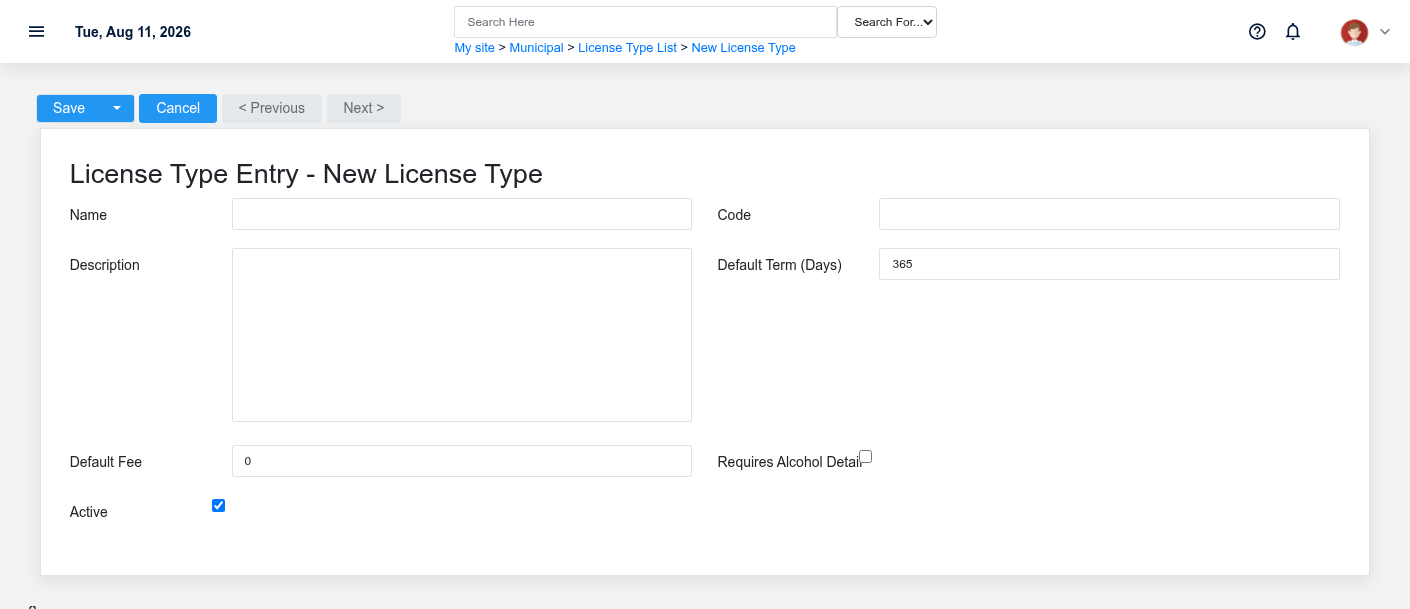
Create a License Type
The License Types create screen in the Brisk documentation demo.
Create a License Type only when the existing choices do not represent the policy or classification you need. Near-duplicate setup values split reporting and make later selection harder.
1. Select the business context first: **Revenue Account**.
2. Enter the required identifying and operational values: **Name**.
3. Review **Requires Alcohol Detail**, and **Active** deliberately; these choices control availability or workflow rather than merely describing the record.
4. Save the License Type, then confirm **Name**, and **Code** on its detail page before continuing.
After saving: Open **License Applications**, and **Licenses** and confirm the License Type appears with the intended label and availability. Keep the old value for historical records when changing it would split or relabel prior reporting.
Delete a License Type
Delete this License Type only if it is an unused duplicate or setup mistake. Once other records refer to it, preserve that history and make the value inactive when the screen provides that option.
If the record is merely obsolete, use **Active** to remove it from future use while preserving existing references.
Before confirming, check for related **License Applications**, and **Licenses**. Brisk may refuse deletion when another record depends on this one; resolve the duplicate or use the supported correction workflow instead of breaking the trail.
On the confirmation page, verify **Name**, and **Code**. After confirmation, return to the License Types list and make sure only the intended License Type was removed.
Review License Type details
Use the detail page as the shared record of what this License Type currently means. Verify **Active** before relying on it for a decision.
Follow **Revenue Account** to determine whether the issue is on this License Type or on one of those linked records.
Next check: Open **License Applications**, and **Licenses** and confirm the License Type appears with the intended label and availability. Keep the old value for historical records when changing it would split or relabel prior reporting.
Edit an existing License Type
Edit this License Type when the underlying policy or classification changed. First determine whether historical transactions should retain the old value; if so, deactivate the old choice and create a new one.
1. Open the detail page. Compare **Revenue Account** with the supporting document or approved request.
2. Recheck **Revenue Account**, and **Active**. These values are most likely to change license, compliance, filing, charge, payment, and official account history.
3. Save the change, return to the list, and confirm that the License Type now appears under the expected **Active**.
After the change: Open **License Applications**, and **Licenses** and confirm the License Type appears with the intended label and availability. Keep the old value for historical records when changing it would split or relabel prior reporting.
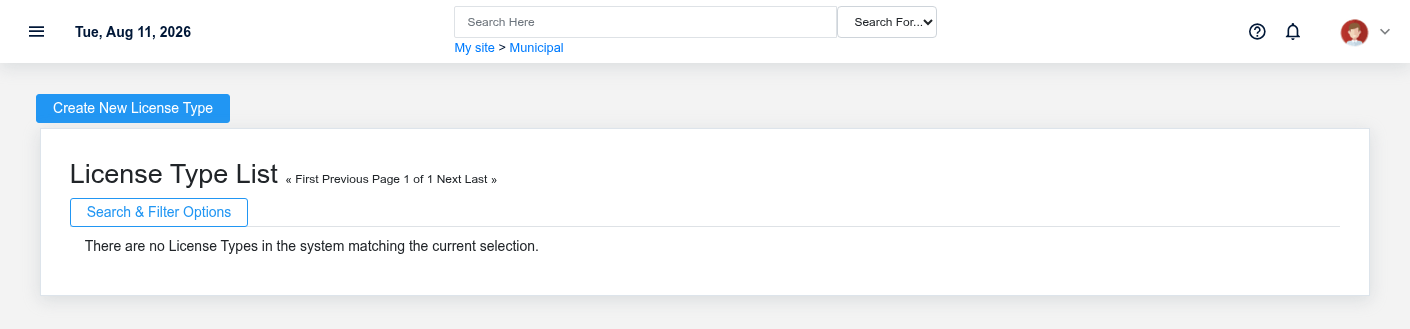
Find and review license types
The License Types list screen in the Brisk documentation demo.
Use the License Types list to find the correct record before opening or changing it. Compare **Name**, and **Code**. Records with similar names or numbers can still belong to different **Revenue Account**.
- The initial order emphasizes **Name**. Select a column heading when you need a different comparison.
Open the License Type whose **Name**, and **Code** match the task. If it is missing, clear the list filters and recheck **Active** rather than creating a replacement immediately.
## Fields and business rules
Brisk stores 8 user-relevant fields for this License Type, including 1 linked-record selection and 0 controlled-choice fields. Create and edit screens may hide calculated or workflow-managed values from this full reference.
| Field | Required | What it controls |
|---|---:|---|
| **Name** | Yes | Human-readable name for this license type. |
| **Code** | No | Short code used to identify this license type. |
| **Description** | No | Description of this license type. |
| **Default Term (Days)** | No | The default term (days) value recorded for this license type. |
| **Default Fee** | No | The default fee value recorded for this license type. |
| **Requires Alcohol Detail** | No | Whether the requires alcohol detail option applies to this license type. |
| **Revenue Account** | No | Optional income account override used when posting municipal charges to accounting. |
| **Active** | No | Whether this license type is active and available for use. |
## What happens next
Open **License Applications**, and **Licenses** and confirm the License Type appears with the intended label and availability. Keep the old value for historical records when changing it would split or relabel prior reporting.
## Common mistakes and troubleshooting
- **The record will not save:** Recheck **Name** and any message beside the field. A required related record may also be inactive or unavailable to your role.
- **The record saved but is not available where expected:** Recheck **Active**, then clear the filters on the destination list. A saved record can still be inactive, unpublished, locked, unapproved, or in the wrong workflow state.
- **The values look right but the result is wrong:** Open **Revenue Account** from the detail page. Correct the specific relationship that is wrong instead of forcing a total or status to compensate for it.
# Licenses
# Licenses
Purpose and when to use this record
Maintain an issued municipal license, its business, type, effective dates, status, conditions, and renewal history.
## At a glance
- **Identify it by:** **License Number**, **Status**, **Issued Date**, **Effective Date**, and **Expiration Date**.
- **Check its business context:** **Account**, **License Type**, and **Source Application**.
- **Why care:** Names, periods, classifications, due dates, status, charges, and payments form an official account history. Correct them from the supporting filing, application, receipt, or ordinance.
- **Why care:** Status communicates workflow progress to other staff. Change it only when the underlying work, approval, payment, or handoff has actually occurred.
## Before you begin
You need the Brisk permission for the action you are taking on licenses. If a Create, Edit, or Delete control is absent, do not work around it with another user’s account; ask an administrator to review your role.
Have valid **Account**, and **License Type** records ready first. Those selections determine where this License belongs and which later screens can find it.
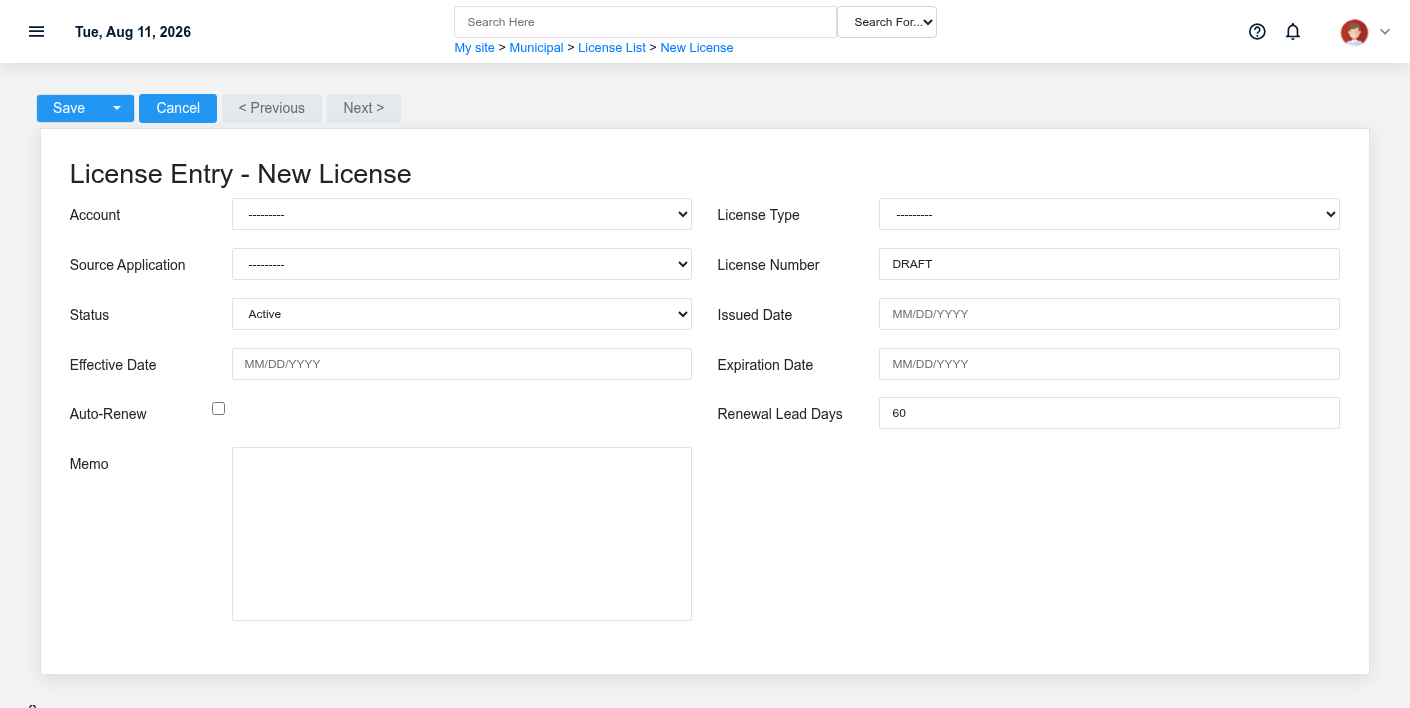
Create a License
The Licenses create screen in the Brisk documentation demo.
Create a License only after confirming that the source document or operational event has not already been entered.
1. Select the business context first: **Account**, **License Type**, and **Source Application**.
2. Enter the required identifying and operational values: **Account**, **License Type**, and **License Number**.
3. Review **Status**, and **Auto-Renew** deliberately; these choices control availability or workflow rather than merely describing the record.
4. Save the License, then confirm **License Number**, **Status**, **Issued Date**, **Effective Date**, and **Expiration Date** on its detail page before continuing.
After saving: Schedule renewal and compliance work from the effective and expiration dates, and keep related payments and conditions with this license.
Delete a License
Delete this License only when it was entered by mistake and no downstream history depends on it. Use a reversal, void, credit, counter-adjustment, or status correction for a real event that later changed.
Before confirming, check for related **Alcohol License Details**, **Compliance Tasks**, and **Municipal Charges**. Brisk may refuse deletion when another record depends on this one; resolve the duplicate or use the supported correction workflow instead of breaking the trail.
On the confirmation page, verify **License Number**, **Status**, **Issued Date**, **Effective Date**, and **Expiration Date**. After confirmation, return to the Licenses list and make sure only the intended License was removed.
Review License details
Use the detail page as the shared record of what this License currently means. Verify **Status**, **Issued Date**, **Effective Date**, and **Expiration Date** before relying on it for a decision.
Follow **Account**, **License Type**, and **Source Application** to determine whether the issue is on this License or on one of those linked records.
Next check: Schedule renewal and compliance work from the effective and expiration dates, and keep related payments and conditions with this license.
Edit an existing License
Edit this License to correct or complete the same source document or operational event; use the supported reversal or follow-up workflow when the business event itself changed.
1. Open the detail page. Compare **Account**, **License Type**, and **Source Application** with the supporting document or approved request.
2. Recheck **Account**, **Status**, **Issued Date**, **Effective Date**, and **Expiration Date**. These values are most likely to change license, compliance, filing, charge, payment, and official account history.
3. Save the change, return to the list, and confirm that the License now appears under the expected **Status**.
After the change: Schedule renewal and compliance work from the effective and expiration dates, and keep related payments and conditions with this license.
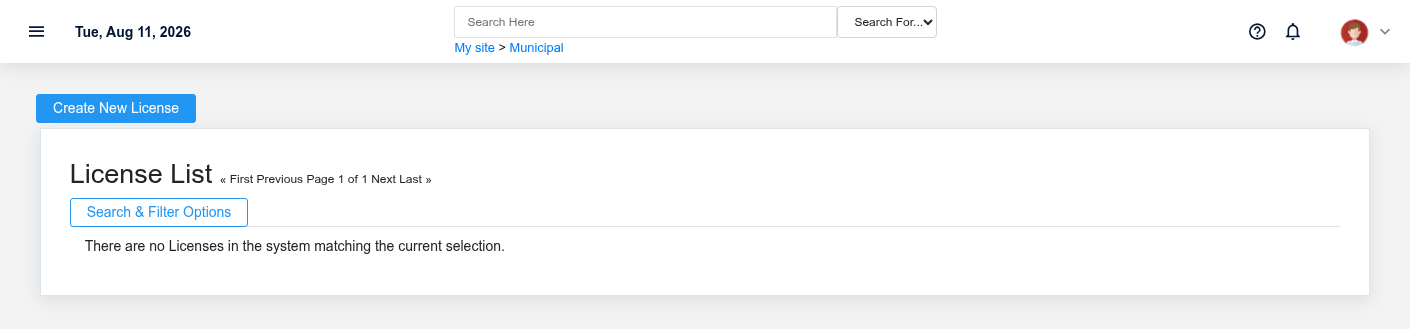
Find and review licenses
The Licenses list screen in the Brisk documentation demo.
Use the Licenses list to find the correct record before opening or changing it. Compare **License Number**, **Status**, **Issued Date**, **Effective Date**, and **Expiration Date**. Records with similar names or numbers can still belong to different **Account**, **License Type**, and **Source Application**.
- The initial order emphasizes **Expiration Date**, and **License Number**. Select a column heading when you need a different comparison.
Open the License whose **License Number**, **Status**, **Issued Date**, **Effective Date**, and **Expiration Date** match the task. If it is missing, clear the list filters and recheck **Status** rather than creating a replacement immediately.
## Fields and business rules
Brisk stores 11 user-relevant fields for this License, including 3 linked-record selections and 1 controlled-choice field. Create and edit screens may hide calculated or workflow-managed values from this full reference.
| Field | Required | What it controls |
|---|---:|---|
| **Account** | Yes | The account associated with this license. |
| **License Type** | Yes | The license type associated with this license. |
| **Source Application** | No | The source application associated with this license. |
| **License Number** | Yes | The license number recorded for this license. |
| **Status** | No | Current status of this license. Available values: Active, Suspended, Expired, Revoked, Closed. |
| **Issued Date** | No | Date recorded for issued date on this license. |
| **Effective Date** | No | Date recorded for effective date on this license. |
| **Expiration Date** | No | Date recorded for expiration date on this license. |
| **Auto-Renew** | No | Whether the auto-renew option applies to this license. |
| **Renewal Lead Days** | No | The renewal lead days value recorded for this license. |
| **Memo** | No | The memo recorded for this license. |
## What happens next
Schedule renewal and compliance work from the effective and expiration dates, and keep related payments and conditions with this license.
## Common mistakes and troubleshooting
- **The record will not save:** Recheck **Account**, **License Type**, and **License Number** and any message beside the field. A required related record may also be inactive or unavailable to your role.
- **The record saved but is not available where expected:** Recheck **Status**, then clear the filters on the destination list. A saved record can still be inactive, unpublished, locked, unapproved, or in the wrong workflow state.
- **The values look right but the result is wrong:** Open **Account**, **License Type**, and **Source Application** from the detail page. Correct the specific relationship that is wrong instead of forcing a total or status to compensate for it.
# Local Tax Filings
# Local Tax Filings
Purpose and when to use this record
Record a local tax return for the filing period, reported basis, tax due, adjustments, and payment state.
## At a glance
- **Identify it by:** **Occupational License Number**, **Business Name**, and **Date Paid**.
- **Check its business context:** **Business**.
- **Why care:** Names, periods, classifications, due dates, status, charges, and payments form an official account history. Correct them from the supporting filing, application, receipt, or ordinance.
- **Why care:** Availability and publication flags affect future use without erasing history. Prefer disabling an obsolete setup record when existing transactions still refer to it.
## Before you begin
You need the Brisk permission for the action you are taking on local tax filings. If a Create, Edit, or Delete control is absent, do not work around it with another user’s account; ask an administrator to review your role.
Create a Local Tax Filing
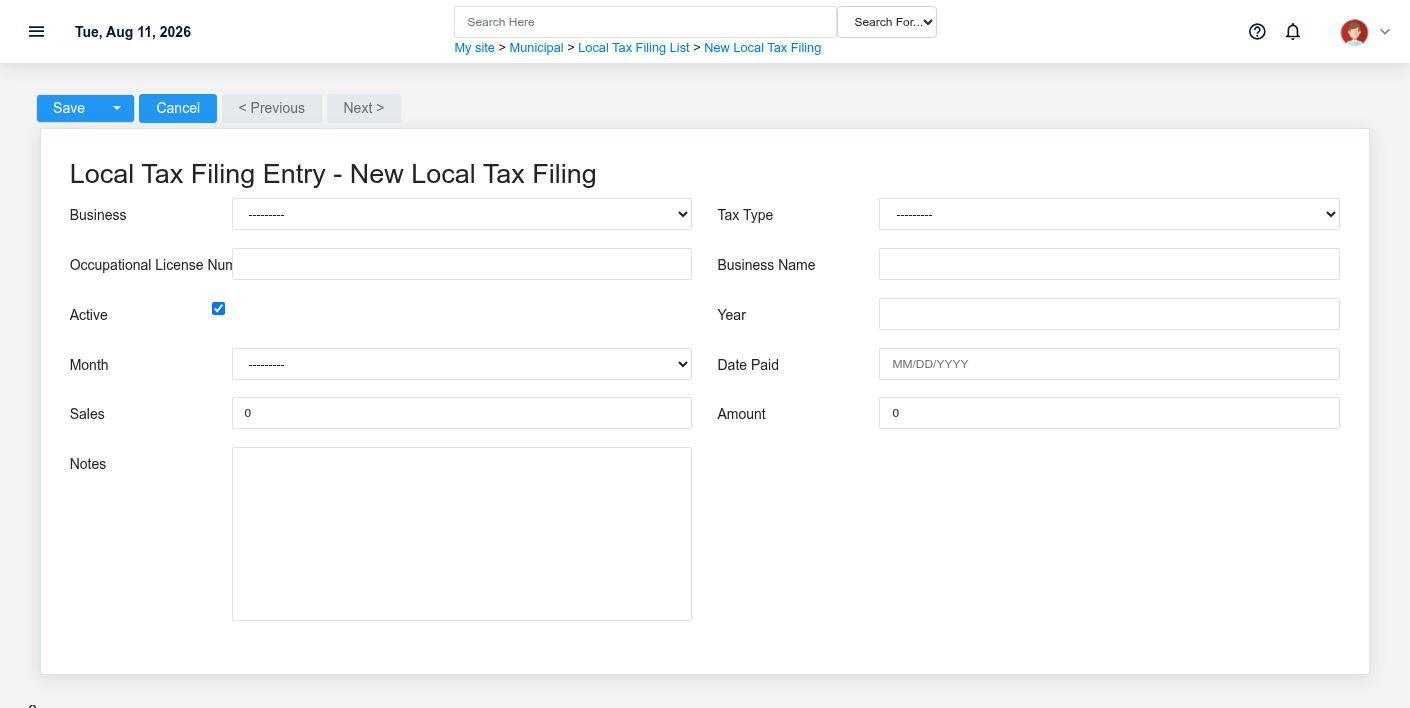
The Local Tax Filings create screen in the Brisk documentation demo.
Create a Local Tax Filing only after confirming that the source document or operational event has not already been entered.
1. Select the business context first: **Business**.
2. Enter the required identifying and operational values: **Tax Type**.
3. Review **Tax Type**, **Active**, and **Month** deliberately; these choices control availability or workflow rather than merely describing the record.
4. Save the Local Tax Filing, then confirm **Occupational License Number**, **Business Name**, and **Date Paid** on its detail page before continuing.
After saving: Compare the calculated amount due with payments and credits, then follow up on any remaining balance or late status.
Delete a Local Tax Filing
Delete this Local Tax Filing only when it was entered by mistake and no downstream history depends on it. Use a reversal, void, credit, counter-adjustment, or status correction for a real event that later changed.
If the record is merely obsolete, use **Active** to remove it from future use while preserving existing references.
On the confirmation page, verify **Occupational License Number**, **Business Name**, and **Date Paid**. After confirmation, return to the Local Tax Filings list and make sure only the intended Local Tax Filing was removed.
Review Local Tax Filing details
Use the detail page as the shared record of what this Local Tax Filing currently means. Verify **Tax Type**, **Active**, **Month**, **Date Paid**, and **Amount** before relying on it for a decision.
Follow **Business** to determine whether the issue is on this Local Tax Filing or on one of those linked records.
Next check: Compare the calculated amount due with payments and credits, then follow up on any remaining balance or late status.
Edit an existing Local Tax Filing
Edit this Local Tax Filing to correct or complete the same source document or operational event; use the supported reversal or follow-up workflow when the business event itself changed.
1. Open the detail page. Compare **Business** with the supporting document or approved request.
2. Recheck **Tax Type**, **Active**, **Month**, **Date Paid**, and **Amount**. These values are most likely to change license, compliance, filing, charge, payment, and official account history.
3. Save the change, return to the list, and confirm that the Local Tax Filing now appears under the expected **Tax Type**, **Active**, **Month**, and **Date Paid**.
After the change: Compare the calculated amount due with payments and credits, then follow up on any remaining balance or late status.
Find and review local tax filings
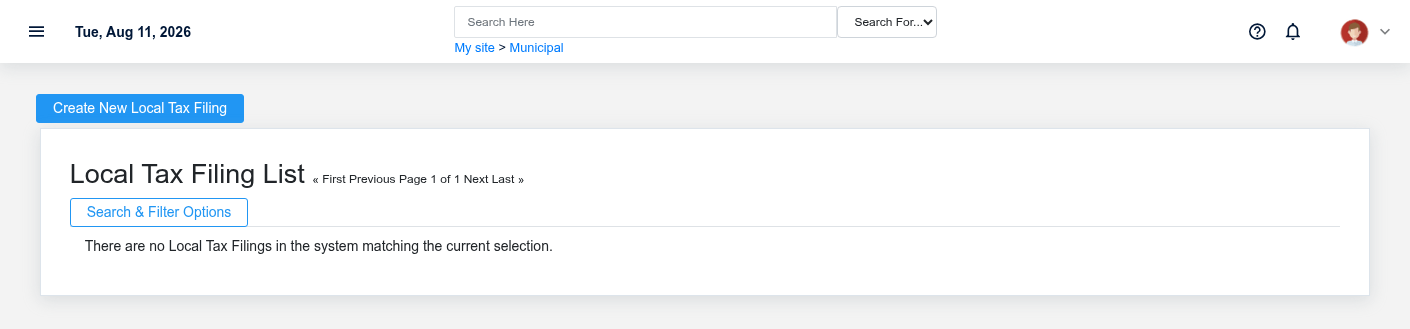
The Local Tax Filings list screen in the Brisk documentation demo.
Use the Local Tax Filings list to find the correct record before opening or changing it. Compare **Occupational License Number**, **Business Name**, and **Date Paid**. Records with similar names or numbers can still belong to different **Business**.
- Keyword search checks **Business Name**, **Tax Type**, and **Month**.
- The initial order emphasizes **Tax Type**, **Year**, **Month**, and **Business Name**. Select a column heading when you need a different comparison.
Open the Local Tax Filing whose **Occupational License Number**, **Business Name**, and **Date Paid** match the task. If it is missing, clear the list filters and recheck **Tax Type**, **Active**, **Month**, and **Date Paid** rather than creating a replacement immediately.
## Fields and business rules
Brisk stores 11 user-relevant fields for this Local Tax Filing, including 1 linked-record selection and 2 controlled-choice fields. Create and edit screens may hide calculated or workflow-managed values from this full reference.
| Field | Required | What it controls |
|---|---:|---|
| **Business** | No | The business associated with this local tax filing. |
| **Tax Type** | Yes | The tax type recorded for this local tax filing. Available values: Restaurant, Room. |
| **Occupational License Number** | No | The occupational license number value recorded for this local tax filing. |
| **Business Name** | No | The business name recorded for this local tax filing. |
| **Active** | No | Whether this local tax filing is active and available for use. |
| **Year** | No | The year value recorded for this local tax filing. |
| **Month** | No | The month recorded for this local tax filing. Available values: Jan, Feb, Mar, Apr, May, Jun, Jul, Aug, Sep, Oct, Nov, Dec. |
| **Date Paid** | No | Date recorded for date paid on this local tax filing. |
| **Sales** | No | The sales value recorded for this local tax filing. |
| **Amount** | No | The amount value recorded for this local tax filing. |
| **Notes** | No | Additional internal notes about this local tax filing. |
## What happens next
Compare the calculated amount due with payments and credits, then follow up on any remaining balance or late status.
## Common mistakes and troubleshooting
- **The record will not save:** Recheck **Tax Type** and any message beside the field. A required related record may also be inactive or unavailable to your role.
- **The record saved but is not available where expected:** Recheck **Tax Type**, **Active**, **Month**, and **Date Paid**, then clear the filters on the destination list. A saved record can still be inactive, unpublished, locked, unapproved, or in the wrong workflow state.
- **The values look right but the result is wrong:** Open **Business** from the detail page. Correct the specific relationship that is wrong instead of forcing a total or status to compensate for it.
# Municipal Accounts
# Municipal Accounts
Purpose and when to use this record
Maintain the account through which a person or business’s municipal charges, filings, payments, and balance are tracked.
## At a glance
- **Identify it by:** **Name**, and **Postal Code**.
- **Check its business context:** **Linked Customer**, and **Linked Vendor**.
- **Why care:** Names, periods, classifications, due dates, status, charges, and payments form an official account history. Correct them from the supporting filing, application, receipt, or ordinance.
- **Why care:** Availability and publication flags affect future use without erasing history. Prefer disabling an obsolete setup record when existing transactions still refer to it.
## Before you begin
You need the Brisk permission for the action you are taking on municipal accounts. If a Create, Edit, or Delete control is absent, do not work around it with another user’s account; ask an administrator to review your role.
Create a Municipal Account
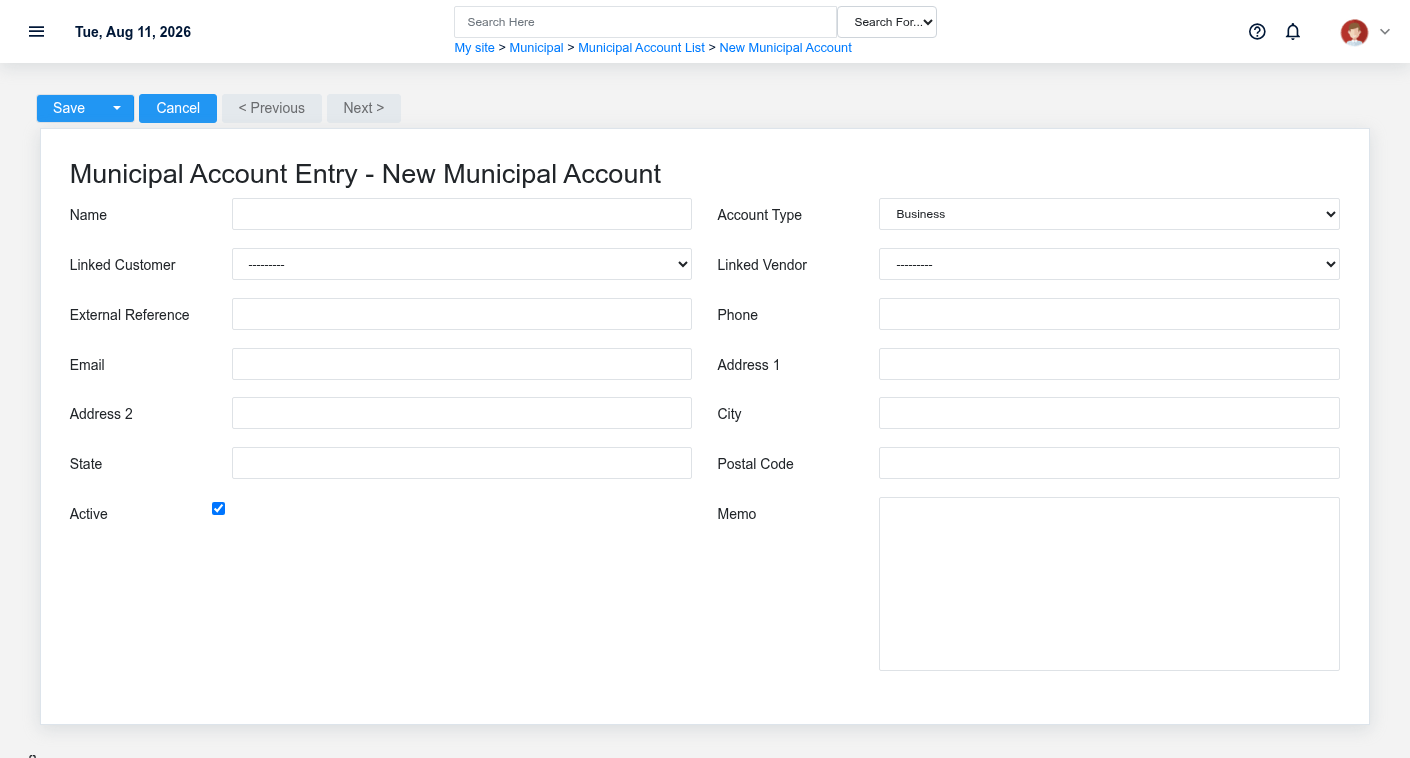
The Municipal Accounts create screen in the Brisk documentation demo.
Create a Municipal Account only after confirming that the source document or operational event has not already been entered.
1. Select the business context first: **Linked Customer**, and **Linked Vendor**.
2. Enter the required identifying and operational values: **Name**.
3. Review **Account Type**, and **Active** deliberately; these choices control availability or workflow rather than merely describing the record.
4. Save the Municipal Account, then confirm **Name**, and **Postal Code** on its detail page before continuing.
After saving: Verify **Account Type**, **Active**, **Linked Customer**, and **Linked Vendor** on the detail page, then continue the municipal workflow only when those values agree with the source document and actual work performed.
Delete a Municipal Account
Delete this Municipal Account only when it was entered by mistake and no downstream history depends on it. Use a reversal, void, credit, counter-adjustment, or status correction for a real event that later changed.
If the record is merely obsolete, use **Active** to remove it from future use while preserving existing references.
Before confirming, check for related **Cemetery Plots**, **Compliance Tasks**, **Interments**, **License Applications**, and **Licenses**, plus the remaining screen fields. Brisk may refuse deletion when another record depends on this one; resolve the duplicate or use the supported correction workflow instead of breaking the trail.
On the confirmation page, verify **Name**, and **Postal Code**. After confirmation, return to the Municipal Accounts list and make sure only the intended Municipal Account was removed.
Review Municipal Account details
Use the detail page as the shared record of what this Municipal Account currently means. Verify **Account Type**, and **Active** before relying on it for a decision.
Follow **Linked Customer**, and **Linked Vendor** to determine whether the issue is on this Municipal Account or on one of those linked records.
Next check: Verify **Account Type**, **Active**, **Linked Customer**, and **Linked Vendor** on the detail page, then continue the municipal workflow only when those values agree with the source document and actual work performed.
Edit an existing Municipal Account
Edit this Municipal Account to correct or complete the same source document or operational event; use the supported reversal or follow-up workflow when the business event itself changed.
1. Open the detail page. Compare **Linked Customer**, and **Linked Vendor** with the supporting document or approved request.
2. Recheck **Account Type**, **Linked Customer**, **Linked Vendor**, and **Active**. These values are most likely to change license, compliance, filing, charge, payment, and official account history.
3. Save the change, return to the list, and confirm that the Municipal Account now appears under the expected **Account Type**, and **Active**.
After the change: Verify **Account Type**, **Active**, **Linked Customer**, and **Linked Vendor** on the detail page, then continue the municipal workflow only when those values agree with the source document and actual work performed.
Find and review municipal accounts
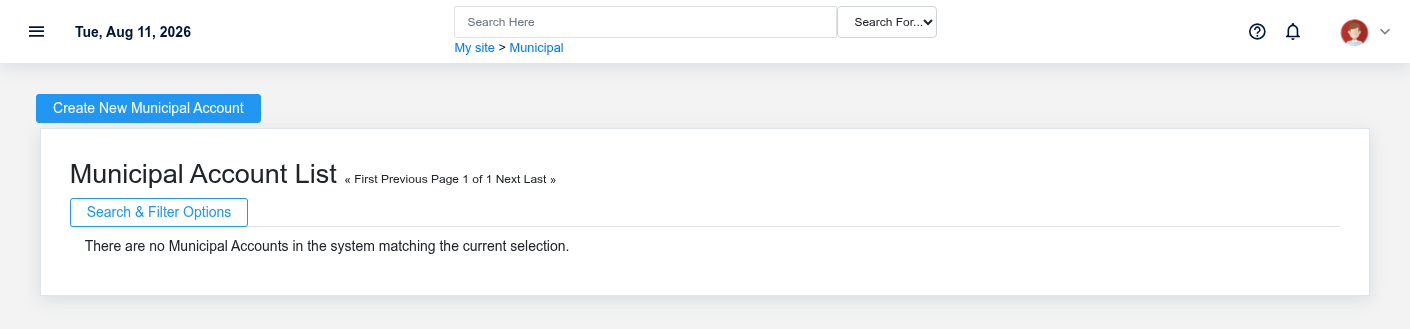
The Municipal Accounts list screen in the Brisk documentation demo.
Use the Municipal Accounts list to find the correct record before opening or changing it. Compare **Name**, and **Postal Code**. Records with similar names or numbers can still belong to different **Linked Customer**, and **Linked Vendor**.
- The initial order emphasizes **Name**. Select a column heading when you need a different comparison.
Open the Municipal Account whose **Name**, and **Postal Code** match the task. If it is missing, clear the list filters and recheck **Account Type**, and **Active** rather than creating a replacement immediately.
## Fields and business rules
Brisk stores 14 user-relevant fields for this Municipal Account, including 2 linked-record selections and 1 controlled-choice field. Create and edit screens may hide calculated or workflow-managed values from this full reference.
| Field | Required | What it controls |
|---|---:|---|
| **Name** | Yes | Human-readable name for this account. |
| **Account Type** | No | The account type recorded for this account. Available values: Business, Individual, Organization. |
| **Linked Customer** | No | The linked customer associated with this account. |
| **Linked Vendor** | No | The linked vendor associated with this account. |
| **External Reference** | No | The external reference recorded for this account. |
| **Phone** | No | The phone recorded for this account. |
| **Email** | No | Email address recorded as email for this account. |
| **Address 1** | No | The address 1 recorded for this account. |
| **Address 2** | No | The address 2 recorded for this account. |
| **City** | No | The city recorded for this account. |
| **State** | No | The state recorded for this account. |
| **Postal Code** | No | The postal code recorded for this account. |
| **Active** | No | Whether this account is active and available for use. |
| **Memo** | No | The memo recorded for this account. |
## What happens next
Verify **Account Type**, **Active**, **Linked Customer**, and **Linked Vendor** on the detail page, then continue the municipal workflow only when those values agree with the source document and actual work performed.
## Common mistakes and troubleshooting
- **The record will not save:** Recheck **Name** and any message beside the field. A required related record may also be inactive or unavailable to your role.
- **The record saved but is not available where expected:** Recheck **Account Type**, and **Active**, then clear the filters on the destination list. A saved record can still be inactive, unpublished, locked, unapproved, or in the wrong workflow state.
- **The values look right but the result is wrong:** Open **Linked Customer**, and **Linked Vendor** from the detail page. Correct the specific relationship that is wrong instead of forcing a total or status to compensate for it.
# Municipal Businesses
# Municipal Businesses
Purpose and when to use this record
Maintain the legal and operating identity used for municipal licensing, tax filings, contacts, and compliance work.
## At a glance
- **Identify it by:** **Occupational License Number**, **Date Open**, **Date Inactive**, **Business Name**, and **Number Of Tax Types**.
- **Check its business context:** **Class 1**, **Class 2**, and **Municipal Account**.
- **Why care:** Names, periods, classifications, due dates, status, charges, and payments form an official account history. Correct them from the supporting filing, application, receipt, or ordinance.
- **Why care:** Availability and publication flags affect future use without erasing history. Prefer disabling an obsolete setup record when existing transactions still refer to it.
## Before you begin
You need the Brisk permission for the action you are taking on municipal businesses. If a Create, Edit, or Delete control is absent, do not work around it with another user’s account; ask an administrator to review your role.
Create a Municipal Business
The Municipal Businesses create screen in the Brisk documentation demo.
Create a Municipal Business only after confirming that the source document or operational event has not already been entered.
1. Select the business context first: **Class 1**, **Class 2**, and **Municipal Account**.
2. Enter the required identifying and operational values: **Business Name**.
3. Review **New**, **Active**, **Business License**, **Net Profit**, **Payroll Tax**, and **Restaurant Tax**, plus the remaining screen fields deliberately; these choices control availability or workflow rather than merely describing the record.
4. Save the Municipal Business, then confirm **Occupational License Number**, **Date Open**, **Date Inactive**, **Business Name**, and **Number Of Tax Types** on its detail page before continuing.
After saving: Verify **Date Inactive**, **Active**, **License Date Paid**, **License Amount Paid**, **Net Profit Date Paid**, and **Net Profit Amount Paid**, plus the remaining screen fields on the detail page, then continue the municipal workflow only when those values agree with the source document and actual work performed.
Delete a Municipal Business
Delete this Municipal Business only when it was entered by mistake and no downstream history depends on it. Use a reversal, void, credit, counter-adjustment, or status correction for a real event that later changed.
If the record is merely obsolete, use **Active** to remove it from future use while preserving existing references.
Before confirming, check for related **Business License Payments**, **Local Tax Filings**, **Net Profit Filings**, and **Payroll Tax Filings**. Brisk may refuse deletion when another record depends on this one; resolve the duplicate or use the supported correction workflow instead of breaking the trail.
On the confirmation page, verify **Occupational License Number**, **Date Open**, **Date Inactive**, **Business Name**, and **Number Of Tax Types**. After confirmation, return to the Municipal Businesses list and make sure only the intended Municipal Business was removed.
Review Municipal Business details
Use the detail page as the shared record of what this Municipal Business currently means. Verify **Date Open**, **Date Inactive**, **Active**, **License Date Paid**, **License Amount Paid**, and **Effective Date**, plus the remaining screen fields before relying on it for a decision.
Follow **Class 1**, **Class 2**, and **Municipal Account** to determine whether the issue is on this Municipal Business or on one of those linked records.
Next check: Verify **Date Inactive**, **Active**, **License Date Paid**, **License Amount Paid**, **Net Profit Date Paid**, and **Net Profit Amount Paid**, plus the remaining screen fields on the detail page, then continue the municipal workflow only when those values agree with the source document and actual work performed.
Edit an existing Municipal Business
Edit this Municipal Business to correct or complete the same source document or operational event; use the supported reversal or follow-up workflow when the business event itself changed.
1. Open the detail page. Compare **Class 1**, **Class 2**, and **Municipal Account** with the supporting document or approved request.
2. Recheck **Date Open**, **Date Inactive**, **Active**, **License Date Paid**, **License Amount Paid**, and **Effective Date**, plus the remaining screen fields. These values are most likely to change license, compliance, filing, charge, payment, and official account history.
3. Save the change, return to the list, and confirm that the Municipal Business now appears under the expected **Date Inactive**, **Active**, **License Date Paid**, **License Amount Paid**, **Net Profit Date Paid**, and **Net Profit Amount Paid**, plus the remaining screen fields.
After the change: Verify **Date Inactive**, **Active**, **License Date Paid**, **License Amount Paid**, **Net Profit Date Paid**, and **Net Profit Amount Paid**, plus the remaining screen fields on the detail page, then continue the municipal workflow only when those values agree with the source document and actual work performed.
Find and review municipal businesses
The Municipal Businesses list screen in the Brisk documentation demo.
Use the Municipal Businesses list to find the correct record before opening or changing it. Compare **Occupational License Number**, **Date Open**, **Date Inactive**, **Business Name**, **Number Of Tax Types**, and **Emergency Phone No**, plus the remaining screen fields. Records with similar names or numbers can still belong to different **Class 1**, **Class 2**, and **Municipal Account**.
- Keyword search checks **Business Name**, **Owner**, **Type Of Business**, **Business Phone**, **City (P)**, and **City (M)**.
- The date filter uses **Expiration Date**; choose a range that matches the business event you are reconciling.
- The initial order emphasizes **Business Name**. Select a column heading when you need a different comparison.
Open the Municipal Business whose **Occupational License Number**, **Date Open**, **Date Inactive**, **Business Name**, **Number Of Tax Types**, and **Emergency Phone No**, plus the remaining screen fields match the task. If it is missing, clear the list filters and recheck **Expiration Date**, **Date Inactive**, **Active**, **License Date Paid**, **License Amount Paid**, and **Net Profit Date Paid**, plus the remaining screen fields rather than creating a replacement immediately.
## Fields and business rules
Brisk stores 55 user-relevant fields for this Municipal Business, including 3 linked-record selections and 0 controlled-choice fields. Create and edit screens may hide calculated or workflow-managed values from this full reference.
| Field | Required | What it controls |
|---|---:|---|
| **Occupational License Number** | No | The occupational license number value recorded for this business. |
| **New** | No | Whether the new option applies to this business. |
| **Date Open** | No | Date recorded for date open on this business. |
| **Date Inactive** | No | Date recorded for date inactive on this business. |
| **Business Name** | Yes | The business name recorded for this business. |
| **Owner** | No | The owner recorded for this business. |
| **Type Of Business** | No | The type of business recorded for this business. |
| **Class 1** | No | The class 1 associated with this business. |
| **Class 2** | No | The class 2 associated with this business. |
| **Zoning Classification** | No | The zoning classification recorded for this business. |
| **Address (P)** | No | The address (p) recorded for this business. |
| **City (P)** | No | The city (p) recorded for this business. |
| **State (P)** | No | The state (p) recorded for this business. |
| **Zip (P)** | No | The zip (p) recorded for this business. |
| **Address (M)** | No | The address (m) recorded for this business. |
| **City (M)** | No | The city (m) recorded for this business. |
| **State (M)** | No | The state (m) recorded for this business. |
| **Zip (M)** | No | The zip (m) recorded for this business. |
| **Number Of Tax Types** | No | The number of tax types value recorded for this business. |
| **Business Phone** | No | The business phone recorded for this business. |
| **Extension** | No | The extension recorded for this business. |
| **Fax** | No | The fax recorded for this business. |
| **Contact** | No | The contact recorded for this business. |
| **Alt Phone** | No | The alt phone recorded for this business. |
| **Cell Phone** | No | The cell phone recorded for this business. |
| **E-Mail** | No | Email address recorded as e-mail for this business. |
| **Emergency Contact Person** | No | The emergency contact person recorded for this business. |
| **Emergency Phone No** | No | The emergency phone no recorded for this business. |
| **Federal Id** | No | The federal id recorded for this business. |
| **Active** | No | Whether this business is active and available for use. |
| **Business License** | No | Whether the business license option applies to this business. |
| **Net Profit** | No | Whether the net profit option applies to this business. |
| **Payroll Tax** | No | Whether the payroll tax option applies to this business. |
| **Restaurant Tax** | No | Whether the restaurant tax option applies to this business. |
| **Room Tax** | No | Whether the room tax option applies to this business. |
| **Amuse Lic** | No | Whether the amuse lic option applies to this business. |
| **Tourism** | No | Whether the tourism option applies to this business. |
| **Alcohol** | No | Whether the alcohol option applies to this business. |
| **Year End** | No | The year end recorded for this business. |
| **License Date Paid** | No | Date recorded for license date paid on this business. |
| **License Amount Paid** | No | The license amount paid value recorded for this business. |
| **Effective Date** | No | Date recorded for effective date on this business. |
| **Expiration Date** | No | Date recorded for expiration date on this business. |
| **Net Profit Date Paid** | No | Date recorded for net profit date paid on this business. |
| **Net Profit Amount Paid** | No | The net profit amount paid value recorded for this business. |
| **Net Profit Extension Filed** | No | Date recorded for net profit extension filed on this business. |
| **Net Profit Amount Paid With Extension** | No | The net profit amount paid with extension value recorded for this business. |
| **Amusement License Date Paid** | No | Date recorded for amusement license date paid on this business. |
| **Amusement License Amount Paid** | No | The amusement license amount paid value recorded for this business. |
| **Write Off** | No | Whether the write off option applies to this business. |
| **Write Off Date** | No | Date recorded for write off date on this business. |
| **Waived Year** | No | The waived year recorded for this business. |
| **Report Year** | No | The report year recorded for this business. |
| **Notes** | No | Additional internal notes about this business. |
| **Municipal Account** | No | The municipal account associated with this business. |
## What happens next
Verify **Date Inactive**, **Active**, **License Date Paid**, **License Amount Paid**, **Net Profit Date Paid**, and **Net Profit Amount Paid**, plus the remaining screen fields on the detail page, then continue the municipal workflow only when those values agree with the source document and actual work performed.
## Common mistakes and troubleshooting
- **The record will not save:** Recheck **Business Name** and any message beside the field. A required related record may also be inactive or unavailable to your role.
- **The record saved but is not available where expected:** Recheck **Date Inactive**, **Active**, **License Date Paid**, **License Amount Paid**, **Net Profit Date Paid**, and **Net Profit Amount Paid**, plus the remaining screen fields, then clear the filters on the destination list. A saved record can still be inactive, unpublished, locked, unapproved, or in the wrong workflow state.
- **The values look right but the result is wrong:** Open **Class 1**, **Class 2**, and **Municipal Account** from the detail page. Correct the specific relationship that is wrong instead of forcing a total or status to compensate for it.
# Municipal Charges
# Municipal Charges
Purpose and when to use this record
Assess a fee, penalty, tax, or other amount to a municipal account with a due date and source.
## At a glance
- **Identify it by:** **Due Date**, and **Status**.
- **Check its business context:** **Account**, **License**, **Application**, **A/R Transaction**, and **Receipt Credit**.
- **Why care:** Names, periods, classifications, due dates, status, charges, and payments form an official account history. Correct them from the supporting filing, application, receipt, or ordinance.
- **Why care:** Status communicates workflow progress to other staff. Change it only when the underlying work, approval, payment, or handoff has actually occurred.
## Before you begin
You need the Brisk permission for the action you are taking on municipal charges. If a Create, Edit, or Delete control is absent, do not work around it with another user’s account; ask an administrator to review your role.
Have valid **Account** records ready first. Those selections determine where this Municipal Charge belongs and which later screens can find it.
Create a Municipal Charge
The Municipal Charges create screen in the Brisk documentation demo.
Create a Municipal Charge only after confirming that the source document or operational event has not already been entered.
1. Select the business context first: **Account**, **License**, **Application**, **A/R Transaction**, and **Receipt Credit**.
2. Enter the required identifying and operational values: **Account**, and **Description**.
3. Review **Status** deliberately; these choices control availability or workflow rather than merely describing the record.
4. Save the Municipal Charge, then confirm **Due Date**, and **Status** on its detail page before continuing.
After saving: Verify **Status**, **Account**, **License**, **Application**, **A/R Transaction**, and **Receipt Credit** on the detail page, then continue the municipal workflow only when those values agree with the source document and actual work performed.
Delete a Municipal Charge
Delete this Municipal Charge only when it was entered by mistake and no downstream history depends on it. Use a reversal, void, credit, counter-adjustment, or status correction for a real event that later changed.
On the confirmation page, verify **Due Date**, and **Status**. After confirmation, return to the Municipal Charges list and make sure only the intended Municipal Charge was removed.
Review Municipal Charge details
Use the detail page as the shared record of what this Municipal Charge currently means. Verify **Due Date**, **Amount**, and **Status** before relying on it for a decision.
Follow **Account**, **License**, **Application**, **A/R Transaction**, and **Receipt Credit** to determine whether the issue is on this Municipal Charge or on one of those linked records.
Next check: Verify **Status**, **Account**, **License**, **Application**, **A/R Transaction**, and **Receipt Credit** on the detail page, then continue the municipal workflow only when those values agree with the source document and actual work performed.
Edit an existing Municipal Charge
Edit this Municipal Charge to correct or complete the same source document or operational event; use the supported reversal or follow-up workflow when the business event itself changed.
1. Open the detail page. Compare **Account**, **License**, **Application**, **A/R Transaction**, and **Receipt Credit** with the supporting document or approved request.
2. Recheck **Account**, **Due Date**, **Amount**, **Status**, and **Receipt Credit**. These values are most likely to change license, compliance, filing, charge, payment, and official account history.
3. Save the change, return to the list, and confirm that the Municipal Charge now appears under the expected **Status**.
After the change: Verify **Status**, **Account**, **License**, **Application**, **A/R Transaction**, and **Receipt Credit** on the detail page, then continue the municipal workflow only when those values agree with the source document and actual work performed.
Find and review municipal charges
The Municipal Charges list screen in the Brisk documentation demo.
Use the Municipal Charges list to find the correct record before opening or changing it. Compare **Due Date**, and **Status**. Records with similar names or numbers can still belong to different **Account**, **License**, **Application**, **A/R Transaction**, and **Receipt Credit**.
- The initial order emphasizes **Due Date**, and **Id**. Select a column heading when you need a different comparison.
Open the Municipal Charge whose **Due Date**, and **Status** match the task. If it is missing, clear the list filters and recheck **Status** rather than creating a replacement immediately.
## Fields and business rules
Brisk stores 10 user-relevant fields for this Municipal Charge, including 5 linked-record selections and 1 controlled-choice field. Create and edit screens may hide calculated or workflow-managed values from this full reference.
| Field | Required | What it controls |
|---|---:|---|
| **Account** | Yes | The account associated with this charge. |
| **License** | No | The license associated with this charge. |
| **Application** | No | The application associated with this charge. |
| **Description** | Yes | Description of this charge. |
| **Due Date** | No | Date recorded for due date on this charge. |
| **Amount** | No | The amount value recorded for this charge. |
| **Status** | No | Current status of this charge. Available values: Open, Partially Paid, Paid, Waived, Written Off. |
| **A/R Transaction** | No | The a/r transaction associated with this charge. |
| **Receipt Credit** | No | The receipt credit associated with this charge. |
| **Memo** | No | The memo recorded for this charge. |
## What happens next
Verify **Status**, **Account**, **License**, **Application**, **A/R Transaction**, and **Receipt Credit** on the detail page, then continue the municipal workflow only when those values agree with the source document and actual work performed.
## Common mistakes and troubleshooting
- **The record will not save:** Recheck **Account**, and **Description** and any message beside the field. A required related record may also be inactive or unavailable to your role.
- **The record saved but is not available where expected:** Recheck **Status**, then clear the filters on the destination list. A saved record can still be inactive, unpublished, locked, unapproved, or in the wrong workflow state.
- **The values look right but the result is wrong:** Open **Account**, **License**, **Application**, **A/R Transaction**, and **Receipt Credit** from the detail page. Correct the specific relationship that is wrong instead of forcing a total or status to compensate for it.
# Net Profit Filings
# Net Profit Filings
Purpose and when to use this record
Record a municipal net-profit return, taxable profit calculation, credits, amount due, and filing status.
## At a glance
- **Identify it by:** **License Number**, **Business Name**, and **Date Filed**.
- **Check its business context:** **Business**.
- **Why care:** Names, periods, classifications, due dates, status, charges, and payments form an official account history. Correct them from the supporting filing, application, receipt, or ordinance.
- **Why care:** Treat posted, processed, paid, reversed, and edit-locked states as controls—not ordinary descriptive fields. Confirm the source transaction before changing any state that the screen permits you to change.
## Before you begin
You need the Brisk permission for the action you are taking on net profit filings. If a Create, Edit, or Delete control is absent, do not work around it with another user’s account; ask an administrator to review your role.
Create a Net Profit Filing
The Net Profit Filings create screen in the Brisk documentation demo.
Create a Net Profit Filing only after confirming that the source document or operational event has not already been entered.
1. Select the business context first: **Business**.
2. Enter the identifying values shown on the form, especially **Business**, **License Number**, **Business Name**, **Year**, **Date Filed**, and **Amount**, plus the remaining screen fields.
3. Review **Write Off**, and **Paid** deliberately; these choices control availability or workflow rather than merely describing the record.
4. Save the Net Profit Filing, then confirm **License Number**, **Business Name**, and **Date Filed** on its detail page before continuing.
After saving: Verify the taxable-profit calculation and credits before accepting payment or closing the filing period.
Delete a Net Profit Filing
Delete this Net Profit Filing only when it was entered by mistake and no downstream history depends on it. Use a reversal, void, credit, counter-adjustment, or status correction for a real event that later changed.
On the confirmation page, verify **License Number**, **Business Name**, and **Date Filed**. After confirmation, return to the Net Profit Filings list and make sure only the intended Net Profit Filing was removed.
Review Net Profit Filing details
Use the detail page as the shared record of what this Net Profit Filing currently means. Verify **Date Filed**, **Amount**, **Amount Paid**, **Net Profit Amount Paid With Extension**, and **Paid** before relying on it for a decision.
Follow **Business** to determine whether the issue is on this Net Profit Filing or on one of those linked records.
Next check: Verify the taxable-profit calculation and credits before accepting payment or closing the filing period.
Edit an existing Net Profit Filing
Edit this Net Profit Filing to correct or complete the same source document or operational event; use the supported reversal or follow-up workflow when the business event itself changed.
1. Open the detail page. Compare **Business** with the supporting document or approved request.
2. Recheck **Date Filed**, **Amount**, **Amount Paid**, and **Net Profit Amount Paid With Extension**. These values are most likely to change license, compliance, filing, charge, payment, and official account history.
3. Save the change, return to the list, and confirm that the Net Profit Filing now appears under the expected **Amount Paid**, **Net Profit Amount Paid With Extension**, and **Paid**.
After the change: Verify the taxable-profit calculation and credits before accepting payment or closing the filing period.
Find and review net profit filings
The Net Profit Filings list screen in the Brisk documentation demo.
Use the Net Profit Filings list to find the correct record before opening or changing it. Compare **License Number**, **Business Name**, and **Date Filed**. Records with similar names or numbers can still belong to different **Business**.
- Keyword search checks **Business Name**.
- The initial order emphasizes **Year**, and **Business Name**. Select a column heading when you need a different comparison.
Open the Net Profit Filing whose **License Number**, **Business Name**, and **Date Filed** match the task. If it is missing, clear the list filters and recheck **Amount Paid**, **Net Profit Amount Paid With Extension**, and **Paid** rather than creating a replacement immediately.
## Fields and business rules
Brisk stores 13 user-relevant fields for this Net Profit Filing, including 1 linked-record selection and 0 controlled-choice fields. Create and edit screens may hide calculated or workflow-managed values from this full reference.
| Field | Required | What it controls |
|---|---:|---|
| **Business** | No | The business associated with this net profit filing. |
| **License Number** | No | The license number value recorded for this net profit filing. |
| **Business Name** | No | The business name recorded for this net profit filing. |
| **Year** | No | The year value recorded for this net profit filing. |
| **Date Filed** | No | Date recorded for date filed on this net profit filing. |
| **Amount** | No | The amount value recorded for this net profit filing. |
| **Amount Paid** | No | The amount paid value recorded for this net profit filing. |
| **Net Profit Extension Filed** | No | Date recorded for net profit extension filed on this net profit filing. |
| **Net Profit Amount Paid With Extension** | No | The net profit amount paid with extension value recorded for this net profit filing. |
| **Net Profit Credit** | No | The net profit credit value recorded for this net profit filing. |
| **Write Off** | No | Whether the write off option applies to this net profit filing. |
| **Paid** | No | Whether the paid option applies to this net profit filing. |
| **Notes** | No | Additional internal notes about this net profit filing. |
## What happens next
Verify the taxable-profit calculation and credits before accepting payment or closing the filing period.
## Common mistakes and troubleshooting
- **The values look right but the result is wrong:** Open **Business** from the detail page. Correct the specific relationship that is wrong instead of forcing a total or status to compensate for it.
# Payroll Tax Filings
# Payroll Tax Filings
Purpose and when to use this record
Record employer payroll-tax wages, withholding, adjustments, amount due, and payment status for a filing period.
## At a glance
- **Identify it by:** **Occupational License Number**, **Business Name**, **Date Paid**, and **Number Of Employees**.
- **Check its business context:** **Business**.
- **Why care:** Names, periods, classifications, due dates, status, charges, and payments form an official account history. Correct them from the supporting filing, application, receipt, or ordinance.
- **Why care:** Availability and publication flags affect future use without erasing history. Prefer disabling an obsolete setup record when existing transactions still refer to it.
## Before you begin
You need the Brisk permission for the action you are taking on payroll tax filings. If a Create, Edit, or Delete control is absent, do not work around it with another user’s account; ask an administrator to review your role.
Create a Payroll Tax Filing
The Payroll Tax Filings create screen in the Brisk documentation demo.
Create a Payroll Tax Filing only after confirming that the source document or operational event has not already been entered.
1. Select the business context first: **Business**.
2. Enter the identifying values shown on the form, especially **Business**, **Occupational License Number**, **Business Name**, **Active**, **Year**, and **Quarter**, plus the remaining screen fields.
3. Review **Active**, **Quarter**, and **Postal Worker/Annual** deliberately; these choices control availability or workflow rather than merely describing the record.
4. Save the Payroll Tax Filing, then confirm **Occupational License Number**, **Business Name**, **Date Paid**, and **Number Of Employees** on its detail page before continuing.
After saving: Reconcile reported wages and withholding to the employer’s payment before the filing is treated as complete.
Delete a Payroll Tax Filing
Delete this Payroll Tax Filing only when it was entered by mistake and no downstream history depends on it. Use a reversal, void, credit, counter-adjustment, or status correction for a real event that later changed.
If the record is merely obsolete, use **Active** to remove it from future use while preserving existing references.
On the confirmation page, verify **Occupational License Number**, **Business Name**, **Date Paid**, and **Number Of Employees**. After confirmation, return to the Payroll Tax Filings list and make sure only the intended Payroll Tax Filing was removed.
Review Payroll Tax Filing details
Use the detail page as the shared record of what this Payroll Tax Filing currently means. Verify **Active**, **Quarter**, **Date Paid**, and **Amount** before relying on it for a decision.
Follow **Business** to determine whether the issue is on this Payroll Tax Filing or on one of those linked records.
Next check: Reconcile reported wages and withholding to the employer’s payment before the filing is treated as complete.
Edit an existing Payroll Tax Filing
Edit this Payroll Tax Filing to correct or complete the same source document or operational event; use the supported reversal or follow-up workflow when the business event itself changed.
1. Open the detail page. Compare **Business** with the supporting document or approved request.
2. Recheck **Active**, **Quarter**, **Date Paid**, and **Amount**. These values are most likely to change license, compliance, filing, charge, payment, and official account history.
3. Save the change, return to the list, and confirm that the Payroll Tax Filing now appears under the expected **Active**, **Quarter**, and **Date Paid**.
After the change: Reconcile reported wages and withholding to the employer’s payment before the filing is treated as complete.
Find and review payroll tax filings
The Payroll Tax Filings list screen in the Brisk documentation demo.
Use the Payroll Tax Filings list to find the correct record before opening or changing it. Compare **Occupational License Number**, **Business Name**, **Date Paid**, and **Number Of Employees**. Records with similar names or numbers can still belong to different **Business**.
- Keyword search checks **Business Name**.
- The initial order emphasizes **Year**, **Quarter**, and **Business Name**. Select a column heading when you need a different comparison.
Open the Payroll Tax Filing whose **Occupational License Number**, **Business Name**, **Date Paid**, and **Number Of Employees** match the task. If it is missing, clear the list filters and recheck **Active**, **Quarter**, and **Date Paid** rather than creating a replacement immediately.
## Fields and business rules
Brisk stores 11 user-relevant fields for this Payroll Tax Filing, including 1 linked-record selection and 1 controlled-choice field. Create and edit screens may hide calculated or workflow-managed values from this full reference.
| Field | Required | What it controls |
|---|---:|---|
| **Business** | No | The business associated with this payroll tax filing. |
| **Occupational License Number** | No | The occupational license number value recorded for this payroll tax filing. |
| **Business Name** | No | The business name recorded for this payroll tax filing. |
| **Active** | No | Whether this payroll tax filing is active and available for use. |
| **Year** | No | The year value recorded for this payroll tax filing. |
| **Quarter** | No | The quarter recorded for this payroll tax filing. Available values: 1, 2, 3, 4. |
| **Date Paid** | No | Date recorded for date paid on this payroll tax filing. |
| **Amount** | No | The amount value recorded for this payroll tax filing. |
| **Number Of Employees** | No | The number of employees value recorded for this payroll tax filing. |
| **Postal Worker/Annual** | No | Whether the postal worker/annual option applies to this payroll tax filing. |
| **Notes** | No | Additional internal notes about this payroll tax filing. |
## What happens next
Reconcile reported wages and withholding to the employer’s payment before the filing is treated as complete.
## Common mistakes and troubleshooting
- **The record saved but is not available where expected:** Recheck **Active**, **Quarter**, and **Date Paid**, then clear the filters on the destination list. A saved record can still be inactive, unpublished, locked, unapproved, or in the wrong workflow state.
- **The values look right but the result is wrong:** Open **Business** from the detail page. Correct the specific relationship that is wrong instead of forcing a total or status to compensate for it.