
Items
Items
Purpose and when to use this record
At a glance
-
Identify it by: Name, Item Code, Barcode, and Point Of Sale Label.
-
Check its business context: Item Class, Vendor, Location, Purchase Uom, and Sales Uom.
-
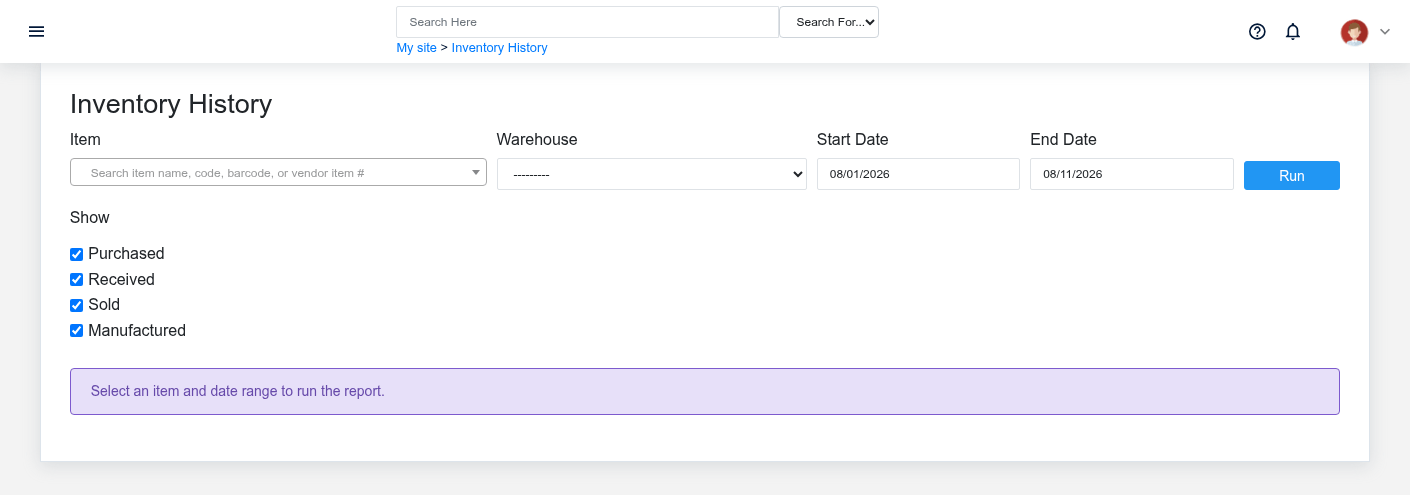
Why care: Warehouse, item, unit, quantity, and cost must describe the same physical movement. A wrong warehouse or unit can make availability and valuation misleading.
Before you begin
You need the Brisk permission for the action you are taking on items. If a Create, Edit, or Delete control is awaitingabsent, workflowdo review.not work around it with another user’s account; ask an administrator to review your role.
Have valid Asset Account, Expense Account, Cogs Account, Revenue Account, and Default Tax records ready first. Those selections determine where this Item belongs and which later screens can find it.
Find and review items

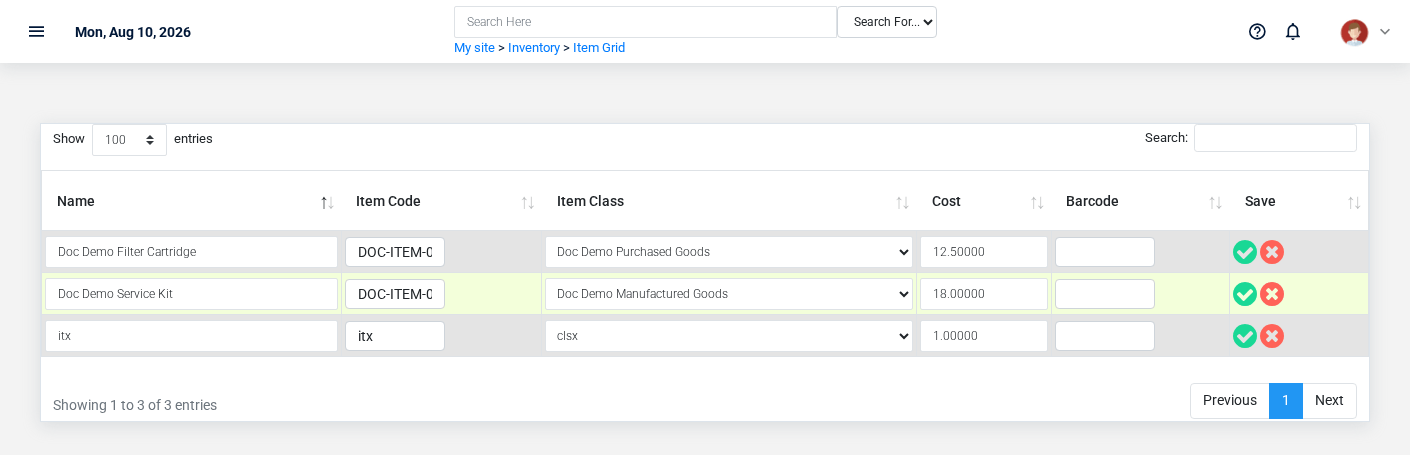
Use the Items list to find the correct record before opening or changing it. Compare Name, Item Code, and Barcode. Records with similar names or numbers can still belong to different Item Class, Vendor, Location, Purchase Uom, Sales Uom, and Stock Uom, plus the remaining screen fields.
-
Keyword search checks Name, Description, Item Code, Vendor Item #, and Item Type.
-
Narrow the list with Item Class, Vendor, and Location filters.
-
The initial order emphasizes Name. Select a column heading when you need a different comparison.
Open the Item whose Name, Item Code, and Barcode match the task. If it is missing, clear the list filters and recheck Item Class, Vendor, Location, Item Type, Commission Type, and Pricing Locked rather than creating a replacement immediately.
Create aan recordItem
TheCreate evidencean packetItem identifiesafter searching for the viewperson, organization, item, location, or resource under alternate names and sourceidentifiers. locationMerge or correct an existing master record instead of creating a duplicate.
-
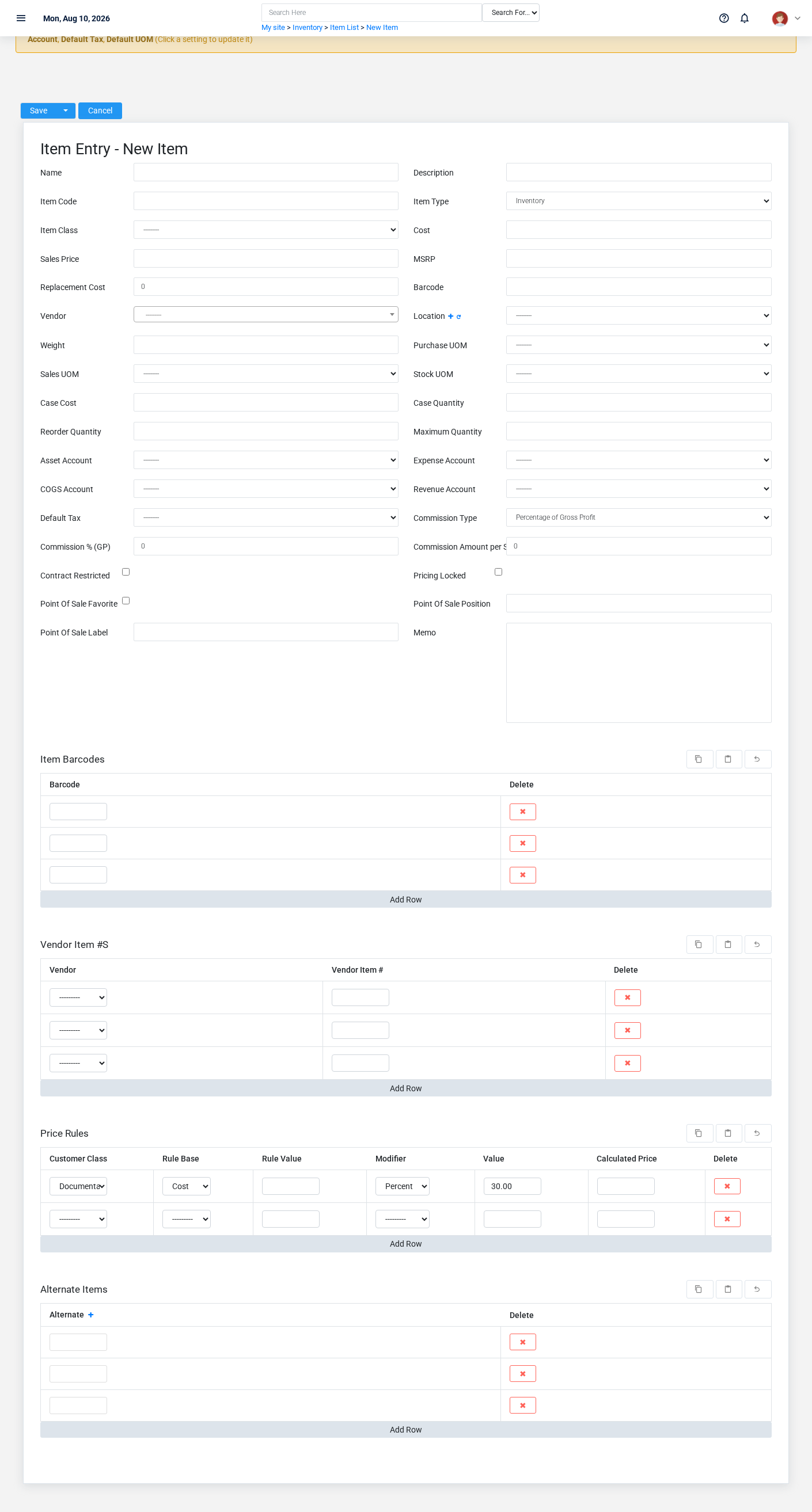
Select the business context first: Item Class, Vendor, Location, Purchase Uom, Sales Uom, and Stock Uom, plus the remaining screen fields.
-
Enter the required identifying and operational values: Name, Cost, Sales Price, Asset Account, Expense Account, and Cogs Account, plus the remaining screen fields.
-
Review Item Type, Commission Type, Contract Restricted, Pricing Locked, Point Of Sale Favorite, and Auto-Prompt Foodservice Options, plus the remaining screen fields deliberately; these choices control availability or workflow rather than merely describing the record.
-
Save the Item, then confirm Name, Item Code, Barcode, and Point Of Sale Label on its detail page before continuing.
After saving: Verify this Item in Adjustment Lines, Alternate Items, Ingredient Information, and Inventory Items Credited, plus the remaining screen fields before staff build new activity on it; correct ownership, classification, and active state now rather than after transactions accumulate.
Delete an Item
Delete this Item only if it is an unused duplicate or setup mistake. Once other records refer to it, preserve that history and make the value inactive when the screen provides that option.
Before confirming, check for thisrelated action.Adjustment ConfirmLines, user-facingAlternate stepsItems, beforeIngredient approvingInformation, Inventory Items Credited, and Inventory Items Recevied, plus the remaining screen fields. Brisk may refuse deletion when another record depends on this page.one; resolve the duplicate or use the supported correction workflow instead of breaking the trail.
On the confirmation page, verify Name, Item Code, Barcode, and Point Of Sale Label. After confirmation, return to the Items list and make sure only the intended Item was removed.
ViewReview recordItem details
The evidence packet identifiesUse the viewdetail page as the shared record of what this Item currently means. Verify Item Type, Commission Type, Commission Amount Per Sales Uom, and sourcePricing locationLocked before relying on it for a decision.
Follow Item Class, Vendor, Location, Purchase Uom, Sales Uom, and Stock Uom, plus the remaining screen fields to determine whether the issue is on this action.Item Confirmor user-facingon stepsone of those linked records.
Next check: Verify this Item in Adjustment Lines, Alternate Items, Ingredient Information, and Inventory Items Credited, plus the remaining screen fields before approvingstaff thisbuild page.
Findactivity on it; correct ownership, classification, and reviewactive records
state The evidence packet identifies the view and source location for this action. Confirm user-facing steps before approving this page.accumulate.
Edit an existing recordItem
TheEdit evidencethis packetItem identifiesto keep the viewsame real-world party, item, location, or resource accurate. Do not repurpose it for a different entity after activity is attached.
-
Open the detail page. Compare Item Class, Vendor, Location, Purchase Uom, Sales Uom, and
sourceStocklocationUom, plus the remaining screen fields with the supporting document or approved request. -
Recheck Item Type, Cost, Sales Price, Replacement Cost, Vendor, and Case Cost, plus the remaining screen fields. These values are most likely to change warehouse availability, replenishment, quantities, and valuation.
-
Save the change, return to the list, and confirm that the Item now appears under the expected Item Type, Commission Type, and Pricing Locked.
After the change: Verify this Item in Adjustment Lines, Alternate Items, Ingredient Information, and Inventory Items Credited, plus the remaining screen fields before staff build new activity on it; correct ownership, classification, and active state now rather than after transactions accumulate.
Fields and business rules
Brisk stores 36 user-relevant fields for this action.Item, Confirmincluding user-facing11 stepslinked-record beforeselections approvingand 2 controlled-choice fields. Create and edit screens may hide calculated or workflow-managed values from this page.full reference.
Delete
| Field | Required | What |
|---|---|---|
| Name | Yes | Human-readable name for this |
| Description | No | Description of this item. |
| Item Code | No | Short code used to identify this item. |
| Item Type | No | The item type recorded for this item. Available values: Inventory, Non-Inventory, Special Order, Service, Manufactured. |
| Item Class | No | The item class associated with this item. |
| Cost | Yes | Represents the current average cost for this product in inventory. For FIFO and LIFO settings, individual transactions will use the actual cost of the inventory that is being used. Under the Average value system, this field will update automatically upon receiving. In Manual and Market settings, this field will never update automatically and will always be used for financial calculations. |
| Sales Price | Yes | Under default settings, this is the sales price for the item. If price scheduling is enabled, this field represents the highest active, schedueld price. |
| Msrp | No | The msrp value recorded for this item. |
| Replacement Cost | No | Used by the manufacturing system, if populated this field will override the calculated system cost for this ingredient Price/Cost updates of manufactured items. |
| Barcode | No | The barcode recorded for this item. |
| Vendor | No | The vendor associated with this item. |
| Location | No | The location associated with this item. |
| Weight | No | Weight in pounds. For accurate shipping weights to calculate, the sales Unit of Measure needs to have a correct ratio for pounds. For example, "Each" should be set to 1.0, "Ton" should be set to 2000. |
| Purchase Uom | No | Unit of measure used when purchasing the item from a vendor. |
| Sales Uom | No | Unit of measure used when selling the item to a customer. |
| Stock Uom | No | Unit of measure used internally for stock management. |
| Case Cost | No | Records the case cost of this item, in combination with case quantity, this field can be used to calculate individual item quantity. |
| Case Quantity | No | Records the case quantity of this item, in combination with case cost. If Case Pricing is enabled, setting to this field to a value other than 0 will cause this item to behave as a bundle of items that will be unpacked into inventory by the receiving ticket. Inventory level tracking will also use case pricing. |
| Reorder Quantity | No | Set this value to the lowest number of items that should be in stock before |
| Maximum Quantity | No | Set this |
| Asset Account | Yes | The asset account associated with this item. |
| Expense Account | Yes | The expense account associated with this item. |
| Cogs Account | Yes | The cogs account associated with this item. |
| Revenue Account | Yes | The revenue account associated with this item. |
| Default Tax | Yes | The default tax associated with this item. |
| Commission Type | No | Controls how salesperson commission is calculated for this item. Available values: Percentage of Gross Profit, Dollar Amount per Sales UOM. |
| Commission % (Gp) | No | Defines commission percentage paid to salesperson on gross profit of item sales. |
| Commission Amount Per Sales Uom | No | Defines fixed dollar commission paid per item sales unit of measure. |
| Contract Restricted | No | If this field is enabled, this item will not be sellable unless the customer has an active contract for it. |
| Pricing Locked | No | If this field is enabled, this item will appear as price-locked on price scheduling screens. |
| Point Of Sale Favorite | No | If this field is enabled, this item will have a button on the front page of the point-of-sale system. |
| Point Of Sale Position | No | Optionally determines the order of this button on the point-of-sale favorites tab. |
| Point Of Sale Label | No | If this field has a value, this will be the label for the item button on the point of sale screen, which can be helpful for differentiating between items or saving space by abbreviating long item names. |
| Auto-Prompt Foodservice Options | No | When enabled in foodservice POS mode, the item opens its kitchen options popup immediately after it is added. |
| Tonnage Taxable | No | Enable for items that should be included in tonnage tax reporting when the seller is responsible for the tonnage tax. |
| Memo | No | The memo recorded for this item. |
What happens next
Verify this Item in Adjustment Lines, Alternate Items, Ingredient Information, and Inventory Items Credited, plus the remaining screen fields before staff build new activity on it; correct ownership, classification, and active state now rather than after transactions accumulate.
Common mistakes and troubleshooting
-
The record will not save: Recheck Name, Cost, Sales Price, Asset Account, Expense Account, and Cogs Account, plus the remaining screen fields and any message beside the field. A required related record may also be inactive or unavailable to your role.
-
The values look right but the result is wrong: Open Item Class, Vendor, Location, Purchase Uom, Sales Uom, and Stock Uom, plus the remaining screen fields from the detail page. Correct the specific relationship that is wrong instead of forcing a total or status to compensate for it.